Citizen complaints, then and now
The 1972 code identified 13 entries for citizen complaints. The current published Table VI also names 13 entries, but the coverage has changed.
In 1972, the list included air compressors, refuse compacting vehicles, and paving breakers. All three have their own sections today, and those sections are absent from the current Table VI. The current list includes section numbers now assigned to construction noise mitigation plans and vehicle alarm provisions. The 2007 revision helps explain how those subjects ended up in the table.
How the 2007 revision changed what the citations point to
The 1985 recodification moved the citizen-complaint provision from § 1403.3—8.09 to § 24-261. Before 2007, Table VI’s reference to § 24-220(b) pointed to the advertising restriction for sound reproduction devices, and its reference to § 24-244 pointed to allowable sound levels. Local Law 113 of 2005, effective July 1, 2007, reassigned § 24-220 to construction noise mitigation plans and moved the sound reproduction rules to § 24-244. It left § 24-261 and its table in place. A 2009 code edition’s editorial note specifically called for Table VI to be updated to reflect the revision. 2009 code, §§ 24-244 and 24-261, including Table VI note · Local Law 113 of 2005, §§ 10 and 18
Today the table cites § 24-244 without a subdivision, so on its face the entry reaches both (a), which concerns unreasonable noise from sound reproduction devices, and (b), which concerns advertising and similar uses. Only the advertising provision appears in the 1972 list and in the pre-2007 list. NYC Quiet reports that DEP has declined to accept complaints under § 24-244(a). We could not verify a published DEP policy on that point. The special compensation language added in 2024 expressly names (b), while the Table VI entry remains § 24-244. Current § 24-244 · Current § 24-261(a), (d) and (e)
Two cross-references to read with care
Table VI still attaches a vehicle-class qualification to § 24-232, which now sets octave-band limits for commercial or business sound sources. It also attaches a capacity threshold above 50,000 BTU per hour (or equivalent) to § 24-237, which now covers sound signals. These track qualifications on the 1972 motor-vehicle and circulation-device entries. The current vehicle and circulation-device standards are in §§ 24-236 and 24-227, respectively. Table VI separately lists § 24-236 and omits § 24-227. The comparison records the references as published and leaves the effect of those mismatches unresolved. § 24-261 · 2005 Noise Code revision
| 1972 Table VI | Current Table VI |
|---|---|
| § 2.09 · Registrations | § 24-208 · Registrations |
| § 2.25 · Noise abatement contract compliance | § 24-216 · Noise abatement contract compliance |
| § 4.03(b) · Sound reproduction devices used for commercial advertising or to attract attention | § 24-244 · Sound reproduction devices. The table cites the whole section. The advertising restriction is in (b). Before the 2007 revision it was listed as § 24-220(b). |
| § 4.11 · Construction hours and variances | No direct match. The current construction-hours and after-hours authorization sections (§§ 24-222 and 24-223) are absent from Table VI. |
| No corresponding plan-specific entry | § 24-220(b) · Timing, duration and contents of construction noise mitigation plans |
| No corresponding plan-specific entry | § 24-224 · Construction without or contrary to a required noise mitigation plan |
| § 5.03 · Motor vehicles, limited to classes (1) and (2) in columns I and II of 1972 Table I | § 24-236 · Motor vehicle sound standards. The old vehicle-class qualification appears alongside § 24-232 in the current table. |
| § 5.07 · Sound and acoustical standards for rapid transit railroads | No direct match. § 24-234 now addresses use of audio devices aboard a rapid transit railroad, bus or ferry. Its closer 1972 counterpart, § 4.03(c), was outside the original complaint list. |
| § 5.11 · Air compressors | Current § 24-226 is absent from Table VI. |
| § 5.13 · Circulation devices rated above 50,000 BTU per hour or equivalent | Current § 24-227 is absent from Table VI. The old capacity qualification appears alongside § 24-237. |
| § 5.15 · Refuse compacting vehicles | Current § 24-225 is absent from Table VI. |
| § 5.19 · Emergency signal devices | § 24-241 · Emergency signal devices |
| § 5.21 · Paving breakers | Current § 24-230 is absent from Table VI. |
| § 6.03 · Allowable levels under ambient noise quality standards | No direct match. § 24-232 sets octave-band limits for commercial or business sound sources and carries the vehicle qualification described above. |
| § 7.01 · Operating certificates and tunneling permits | § 24-245 · Operating certificates and tunneling permits |
| Related provisions in § 4.05 were outside Table VI. | § 24-237 · Sound signals, including horns and certain vendor signals, with the circulation-device qualification described above. |
| Related alarm provisions in § 4.05(4) were outside Table VI. | § 24-238 · Audible burglar alarms and vehicle alarm-status indicators |
| Related alarm provisions in § 4.05(4) were outside Table VI. | § 24-240 · Removal of vehicles with audible alarms or status indicators |
THE CITY OF NEW YORK
JOHN V. LINDSAY, Mayor
LOCAL LAW No. 57
NOISE CONTROL CODE
Effective September 1, 1972
1664
Published by
THE CITY RECORD
Henry M. Christman, Director
For Sale at
THE CITY RECORD SALES OFFICE
31 Chambers Street, New York, N. Y. 10007
Telephone: 566-2616
Price $1.50
By Mail $1.75
346
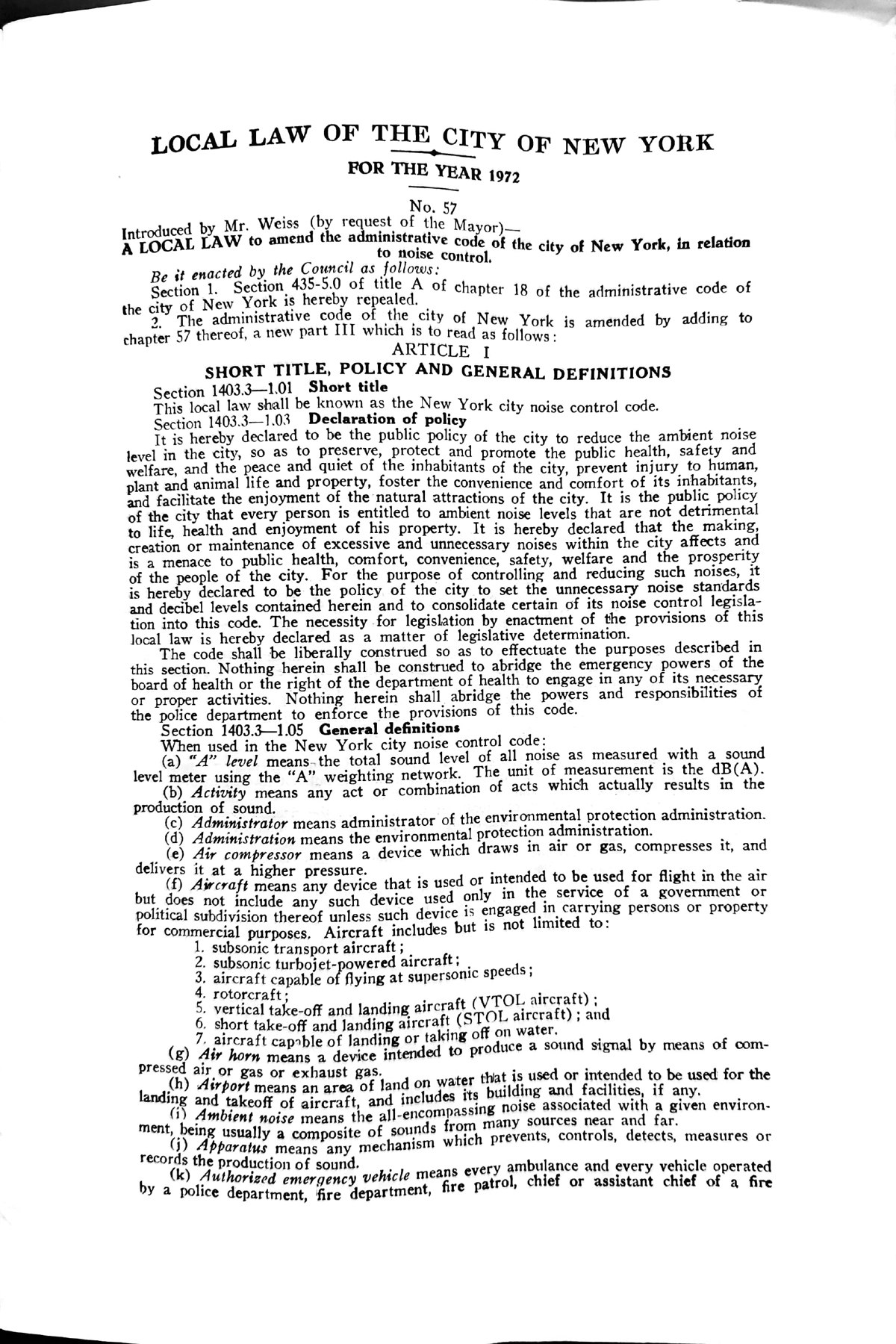
Local Law of the City of New York for the year 1972, No. 57
Introduced by Mr. Weiss (by request of the Mayor)— A LOCAL LAW to amend the administrative code of the city of New York, in relation to noise control.
Be it enacted by the Council as follows:
Section 1. Section 435-5.0 of title A of chapter 18 of the administrative code of the city of New York is hereby repealed.
§ 2. The administrative code of the city of New York is amended by adding to chapter 57 thereof, a new part III which is to read as follows:
ARTICLE ISHORT TITLE, POLICY AND GENERAL DEFINITIONS
Section 1403.3—1.01 Short title
This local law shall be known as the New York city noise control code.
Section 1403.3—1.03 Declaration of policy
It is hereby declared to be the public policy of the city to reduce the ambient noise level in the city, so as to preserve, protect and promote the public health, safety and welfare, and the peace and quiet of the inhabitants of the city, prevent injury to human, plant and animal life and property, foster the convenience and comfort of its inhabitants, and facilitate the enjoyment of the natural attractions of the city. It is the public policy of the city that every person is entitled to ambient noise levels that are not detrimental to life, health and enjoyment of his property. It is hereby declared that the making, creation or maintenance of excessive and unnecessary noises within the city affects and is a menace to public health, comfort, convenience, safety, welfare and the prosperity of the people of the city. For the purpose of controlling and reducing such noises, it is hereby declared to be the policy of the city to set the unnecessary noise standards and decibel levels contained herein and to consolidate certain of its noise control legislation into this code. The necessity for legislation by enactment of the provisions of this local law is hereby declared as a matter of legislative determination.
The code shall be liberally construed so as to effectuate the purposes described in this section. Nothing herein shall be construed to abridge the emergency powers of the board of health or the right of the department of health to engage in any of its necessary or proper activities. Nothing herein shall abridge the powers and responsibilities of the police department to enforce the provisions of this code.
Section 1403.3—1.05 General definitions
When used in the New York city noise control code:
(a) "A" level means the total sound level of all noise as measured with a sound level meter using the "A" weighting network. The unit of measurement is the dB(A).
(b) Activity means any act or combination of acts which actually results in the production of sound.
(c) Administrator means administrator of the environmental protection administration.
(d) Administration means the environmental protection administration.
(e) Air compressor means a device which draws in air or gas, compresses it, and delivers it at a higher pressure.
(f) Aircraft means any device that is used or intended to be used for flight in the air but does not include any such device used only in the service of a government or political subdivision thereof unless such device is engaged in carrying persons or property for commercial purposes. Aircraft includes but is not limited to:
1. subsonic transport aircraft;
2. subsonic turbojet-powered aircraft;
3. aircraft capable of flying at supersonic speeds;
4. rotorcraft;
5. vertical take-off and landing aircraft (VTOL aircraft);
6. short take-off and landing aircraft (STOL aircraft); and
7. aircraft capable of landing or taking off on water.
(g) Air horn means a device intended to produce a sound signal by means of compressed air or gas or exhaust gas.
(h) Airport means an area of land on water that is used or intended to be used for the landing and takeoff of aircraft, and includes its building and facilities, if any.
(i) Ambient noise means the all-encompassing noise associated with a given environment, being usually a composite of sounds from many sources near and far.
(j) Apparatus means any mechanism which prevents, controls, detects, measures or records the production of sound.
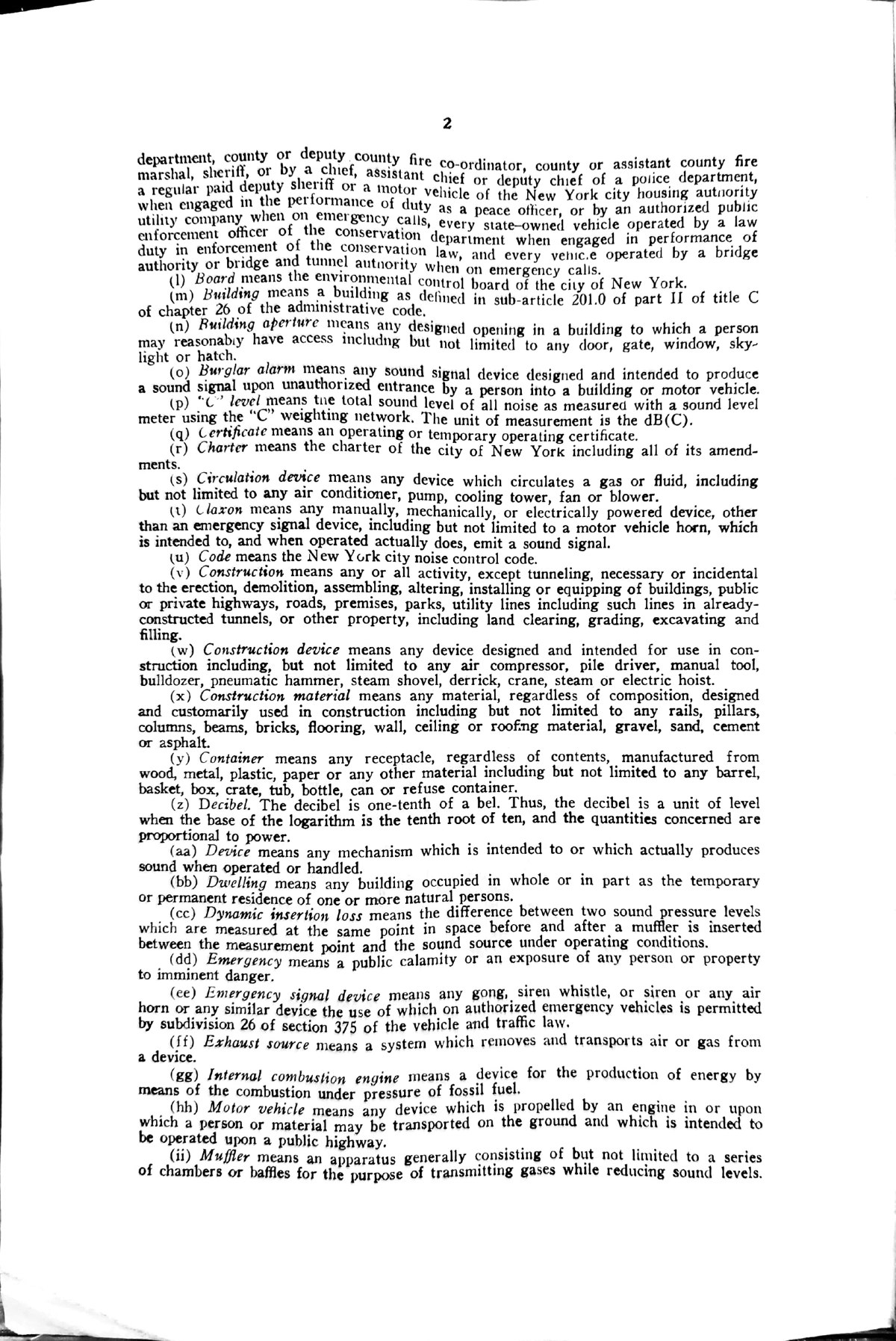
(k) Authorized emergency vehicle means every ambulance and every vehicle operated by a police department, fire department, fire patrol, chief or assistant chief of a fire
department, county or deputy county fire CO-ordinator, county or assistant county fire marshal, sheriff, or by a chief, assistant chief or deputy chief of a police department, a regular paid deputy sheriff or a motor vehicle of the New York city housing authority when engaged in the performance of duty as a peace officer, or by an authorized public utility company when on emergency calls, every state-owned vehicle operated by a law enforcement officer of the conservation department when engaged in performance of duty in enforcement of the conservation law, and every vehicle operated by a bridge authority or bridge and tunnel authority when on emergency calls.
(l) Board means the environmental control board of the city of New York.
(m) Building means a building as defined in sub-article 201.0 of part II of title C of chapter 26 of the administrative code.
(n) Building aperture means any designed opening in a building to which a person may reasonably have access including but not limited to any door, gate, window, skylight or hatch.
(o) Burglar alarm means any sound signal device designed and intended to produce a sound signal upon unauthorized entrance by a person into a building or motor vehicle.
(p) "C" level means the total sound level of all noise as measured with a sound level meter using the "C" weighting network. The unit of measurement is the dB(C).
(q) Certificate means an operating or temporary operating certificate.
(r) Charter means the charter of the city of New York including all of its amendments.
(s) Circulation device means any device which circulates a gas or fluid, including but not limited to any air conditioner, pump, cooling tower, fan or blower.
(t) Claxon means any manually, mechanically, or electrically powered device, other than an emergency signal device, including but not limited to a motor vehicle horn, which is intended to, and when operated actually does, emit a sound signal.
(u) Code means the New York city noise control code.
(v) Construction means any or all activity, except tunneling, necessary or incidental to the erection, demolition, assembling, altering, installing or equipping of buildings, public or private highways, roads, premises, parks, utility lines including such lines in already-constructed tunnels, or other property, including land clearing, grading, excavating and filling.
(w) Construction device means any device designed and intended for use in construction including, but not limited to any air compressor, pile driver, manual tool, bulldozer, pneumatic hammer, steam shovel, derrick, crane, steam or electric hoist.
(x) Construction material means any material, regardless of composition, designed and customarily used in construction including but not limited to any rails, pillars, columns, beams, bricks, flooring, wall, ceiling or roofing material, gravel, sand, cement or asphalt.
(y) Container means any receptacle, regardless of contents, manufactured from wood, metal, plastic, paper or any other material including but not limited to any barrel, basket, box, crate, tub, bottle, can or refuse container.
(z) Decibel. The decibel is one-tenth of a bel. Thus, the decibel is a unit of level when the base of the logarithm is the tenth root of ten, and the quantities concerned are proportional to power.
(aa) Device means any mechanism which is intended to or which actually produces sound when operated or handled.
(bb) Dwelling means any building occupied in whole or in part as the temporary or permanent residence of one or more natural persons.
(cc) Dynamic insertion loss means the difference between two sound pressure levels which are measured at the same point in space before and after a muffler is inserted between the measurement point and the sound source under operating conditions.
(dd) Emergency means a public calamity or an exposure of any person or property to imminent danger.
(ee) Emergency signal device means any gong, siren whistle, or siren or any air horn or any similar device the use of which on authorized emergency vehicles is permitted by subdivision 26 of section 375 of the vehicle and traffic law.
(ff) Exhaust source means a system which removes and transports air or gas from a device.
(gg) Internal combustion engine means a device for the production of energy by means of the combustion under pressure of fossil fuel.
(hh) Motor vehicle means any device which is propelled by an engine in or upon which a person or material may be transported on the ground and which is intended to be operated upon a public highway.
(ii) Muffler means an apparatus generally consisting of but not limited to a series of chambers or baffles for the purpose of transmitting gases while reducing sound levels.
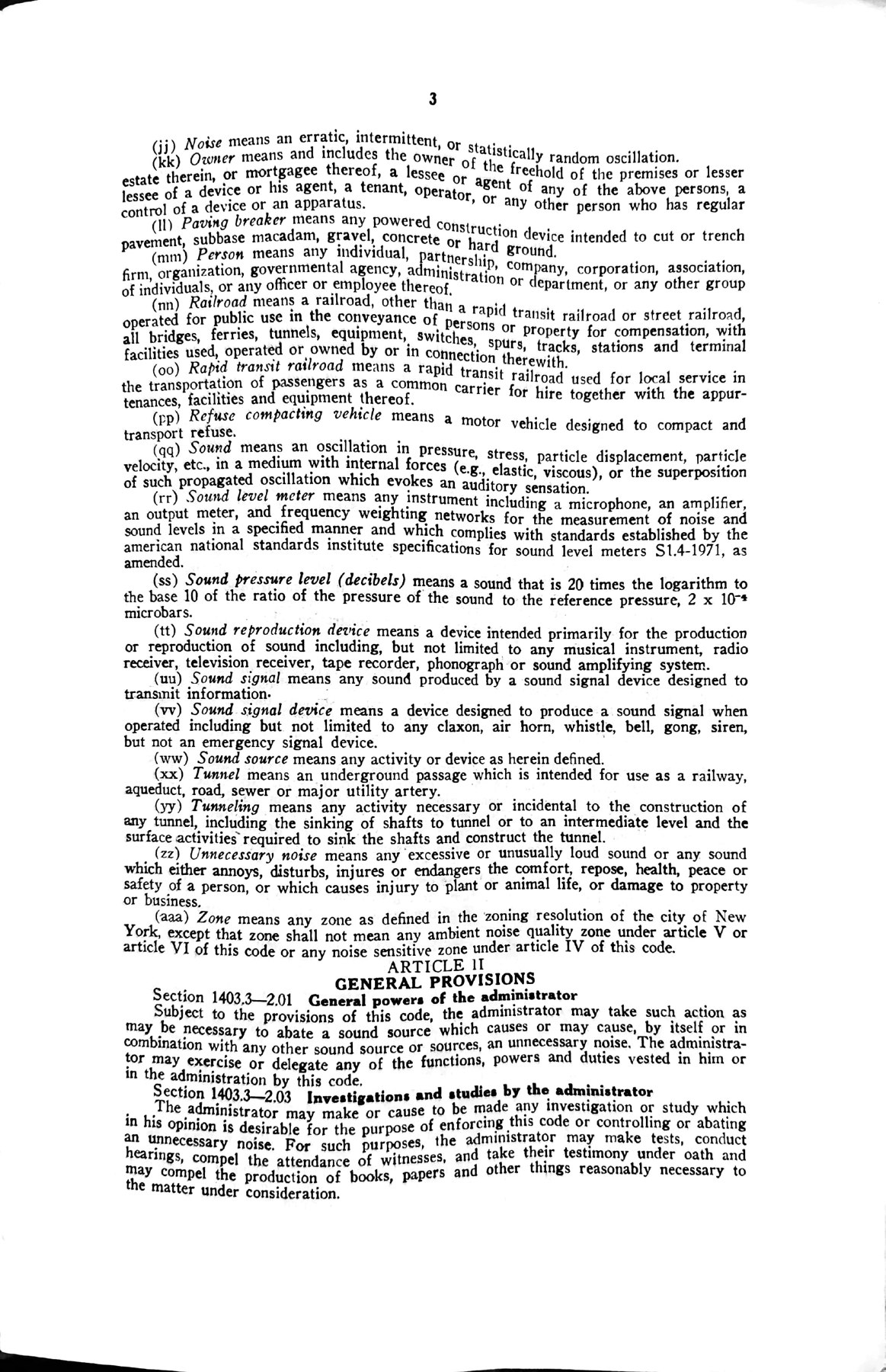
(jj) Noise means an erratic, intermittent, or statistically random oscillation.
(kk) Owner means and includes the owner of the freehold of the premises or lesser estate therein, or mortgagee thereof, a lessee or agent of any of the above persons, a lessee of a device or his agent, a tenant, operator, or any other person who has regular control of a device or an apparatus.
(ll) Paving breaker means any powered construction device intended to cut or trench pavement, subbase macadam, gravel, concrete or hard ground.
(mm) Person means any individual, partnership, company, corporation, association, firm, organization, governmental agency, administration or department, or any other group of individuals, or any officer or employee thereof.
(nn) Railroad means a railroad, other than a rapid transit railroad or street railroad, operated for public use in the conveyance of persons or property for compensation, with all bridges, ferries, tunnels, equipment, switches, spurs, tracks, stations and terminal facilities used, operated or owned by or in connection therewith.
(oo) Rapid transit railroad means a rapid transit railroad used for local service in the transportation of passengers as a common carrier for hire together with the appurtenances, facilities and equipment thereof.
(pp) Refuse compacting vehicle means a motor vehicle designed to compact and transport refuse.
(qq) Sound means an oscillation in pressure, stress, particle displacement, particle velocity, etc., in a medium with internal forces (e.g., elastic, viscous), or the superposition of such propagated oscillation which evokes an auditory sensation.
(rr) Sound level meter means any instrument including a microphone, an amplifier, an output meter, and frequency weighting networks for the measurement of noise and sound levels in a specified manner and which complies with standards established by the american national standards institute specifications for sound level meters S1.4-1971, as amended.
(ss) Sound pressure level (decibels) means a sound that is 20 times the logarithm to the base 10 of the ratio of the pressure of the sound to the reference pressure, 2 x 10⁻⁴ microbars.
(tt) Sound reproduction device means a device intended primarily for the production or reproduction of sound including, but not limited to any musical instrument, radio receiver, television receiver, tape recorder, phonograph or sound amplifying system.
(uu) Sound signal means any sound produced by a sound signal device designed to transmit information.
(vv) Sound signal device mans a device designed to produce a sound signal when operated including but not limited to any claxon, air horn, whistle, bell, gong, siren, but not an emergency signal device.
(ww) Sound source means any activity or device as herein defined.
(xx) Tunnel means an underground passage which is intended for use as a railway, aqueduct, road, sewer or major utility artery.
(yy) Tunneling means any activity necessary or incidental to the construction of any tunnel, including the sinking of shafts to tunnel or to an intermediate level and the surface activities required to sink the shafts and construct the tunnel.
(zz) Unnecessary noise means any excessive or unusually loud sound or any sound which either annoys, disturbs, injures or endangers the comfort, repose, health, peace or safety of a person, or which causes injury to plant or animal life, or damage to property or business.
(aaa) Zone means any zone as defined in the zoning resolution of the city of New York, except that zone shall not mean any ambient noise quality zone under article V or article VI of this code or any noise sensitive zone under article IV of this code.
ARTICLE IIGENERAL PROVISIONS
Section 1403.3—2.01 General powers of the administrator
Subject to the provisions of this code, the administrator may take such action as may be necessary to abate a sound source which causes or may cause, by itself or in combination with any other sound source or sources, an unnecessary noise. The administrator may exercise or delegate any of the functions, powers and duties vested in him or in the administration by this code.
Section 1403.3—2.03 Investigations and studies by the administrator
The administrator may make or cause to be made any investigation or study which in his opinion is desirable for the purpose of enforcing this code or controlling or abating an unnecessary noise. For such purposes, the administrator may make tests, conduct hearings, compel the attendance of witnesses, and take their testimony under oath and may compel the production of books, papers and other things reasonably necessary to the matter under consideration.
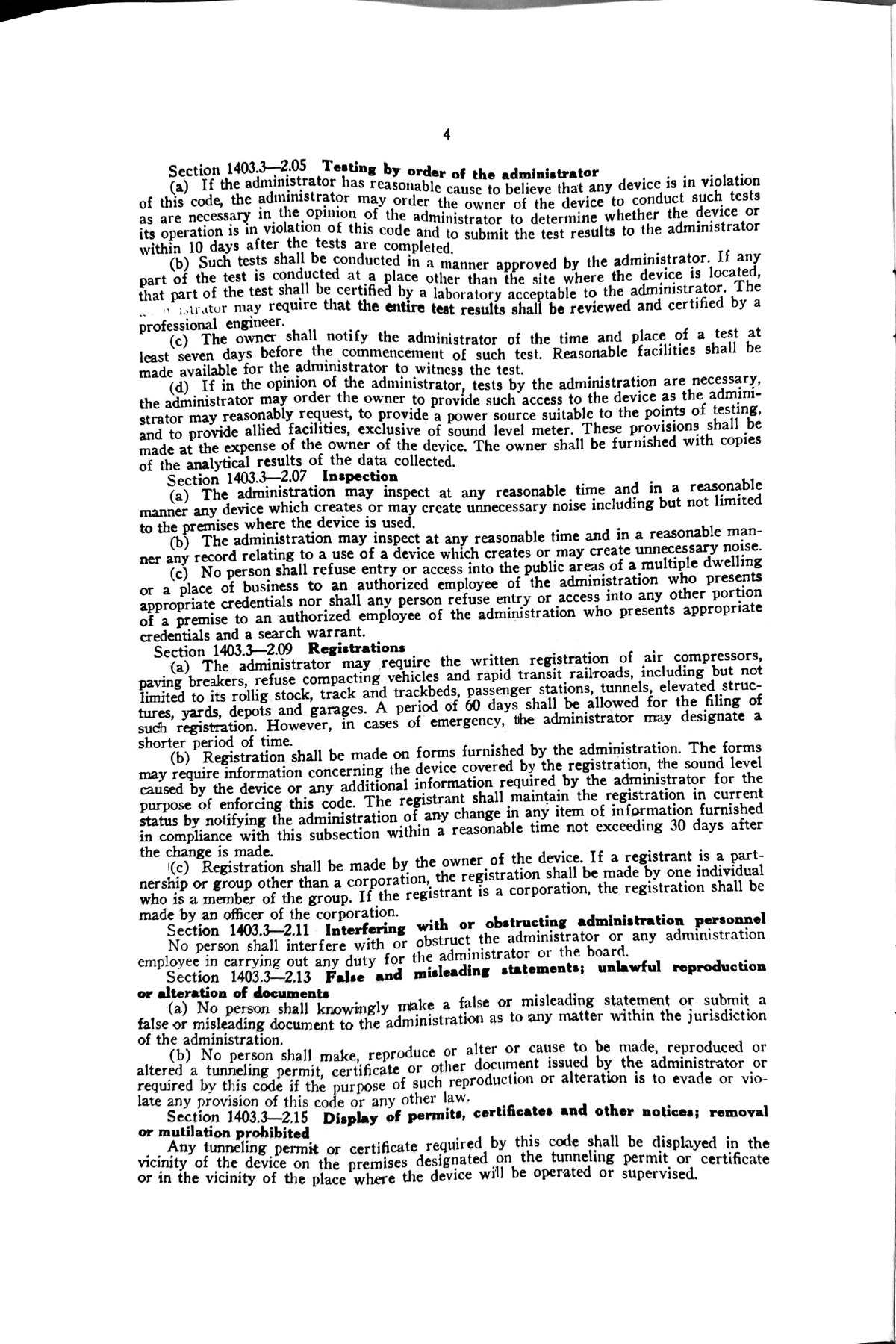
Section 1403.3—2.05 Testing by order of the administrator
(a) If the administrator has reasonable cause to believe that any device is in violation of this code, the administrator may order the owner of the device to conduct such tests as are necessary in the opinion of the administrator to determine whether the device or its operation is in violation of this code and to submit the test results to the administrator within 10 days after the tests are completed.
(b) such tests shall be conducted in a manner approved by the administrator. If any part of the test is conducted at a place other than the site where the device is located, that part of the test shall be certified by a laboratory acceptable to the administrator. The [administrator?] may require that the entire test results shall be reviewed and certified by a professional engineer.
(c) The owner shall notify the administrator of the time and place of a test at least seven days before the commencement of such test. Reasonable facilities shall be made available for the administrator to witness the test.
(d) If in the opinion of the administrator, tests by the administration are necessary, the administrator may order the owner to provide such access to the device as the administrator may reasonably request, to provide a power source suitable to the points of testing, and to provide allied facilities, exclusive of sound level meter. These provisions shall be made at the expense of the owner of the device. The owner shall be furnished with copies of the analytical results of the data collected.
Section 1403.3—2.07 Inspection
(a) The administration may inspect at any reasonable time and in a reasonable manner any device which creates or may create unnecessary noise including but not limited to the premises where the device is used.
(b) The administration may inspect at any reasonable time and in a reasonable manner any record relating to a use of a device which creates or may create unnecessary noise.
(c) No person shall refuse entry or access into the public areas of a multiple dwelling or a place of business to an authorized employee of the administration who presents appropriate credentials nor shall any person refuse entry or access into any other portion of a premise to an authorized employee of the administration who presents appropriate credentials and a search warrant.
Section 1403.3—2.09 Registrations
(a) The administrator may require the written registration of air compressors, paving breakers, refuse compacting vehicles and rapid transit railroads, including but not limited to its rolling stock, track and trackbeds, passenger stations, tunnels, elevated structures, yards, depots and garages. A period of 60 days shall be allowed for the filing of such registration. However, in cases of emergency, the administrator may designate a shorter period of time.
(b) Registration shall be made on forms furnished by the administration. The forms may require information concerning the device covered by the registration, the sound level caused by the device or any additional information required by the administrator for the purpose of enforcing this code. The registrant shall maintain the registration in current status by notifying the administration of any change in any item of information furnished in compliance with this subsection within a reasonable time not exceeding 30 days after the change is made.
(c) Registration shall be made by the owner of the device. If a registrant is a partnership or group other than a corporation, the registration shall be made by one individual who is a member of the group. If the registrant is a corporation, the registration shall be made by an officer of the corporation.
Section 1403.3—2.11 Interfering with or obstructing administration personnel
No person shall interfere with or obstruct the administrator or any administration employee in carrying out any duty for the administrator or the board.
Section 1403.3—2.13 False and misleading statements; unlawful reproduction or alteration of documents
(a) No person shall knowingly make a false or misleading statement or submit a false or misleading document to the administration as to any matter within the jurisdiction of the administration.
(b) No person shall make, reproduce or alter or cause to be made, reproduced or altered a tunneling permit, certificate or other document issued by the administrator or required by this code if the purpose of such reproduction or alteration is to evade or violate any provision of this code or any other law.
Section 1403.3—2.15 Display of permits, certificates and other notices; removal or mutilation prohibited
Any tunneling permit or certificate required by this code shall be displayed in the vicinity of the device on the premises designated on the tunneling permit or certificate or in the vicinity of the place where the device will be operated or supervised.
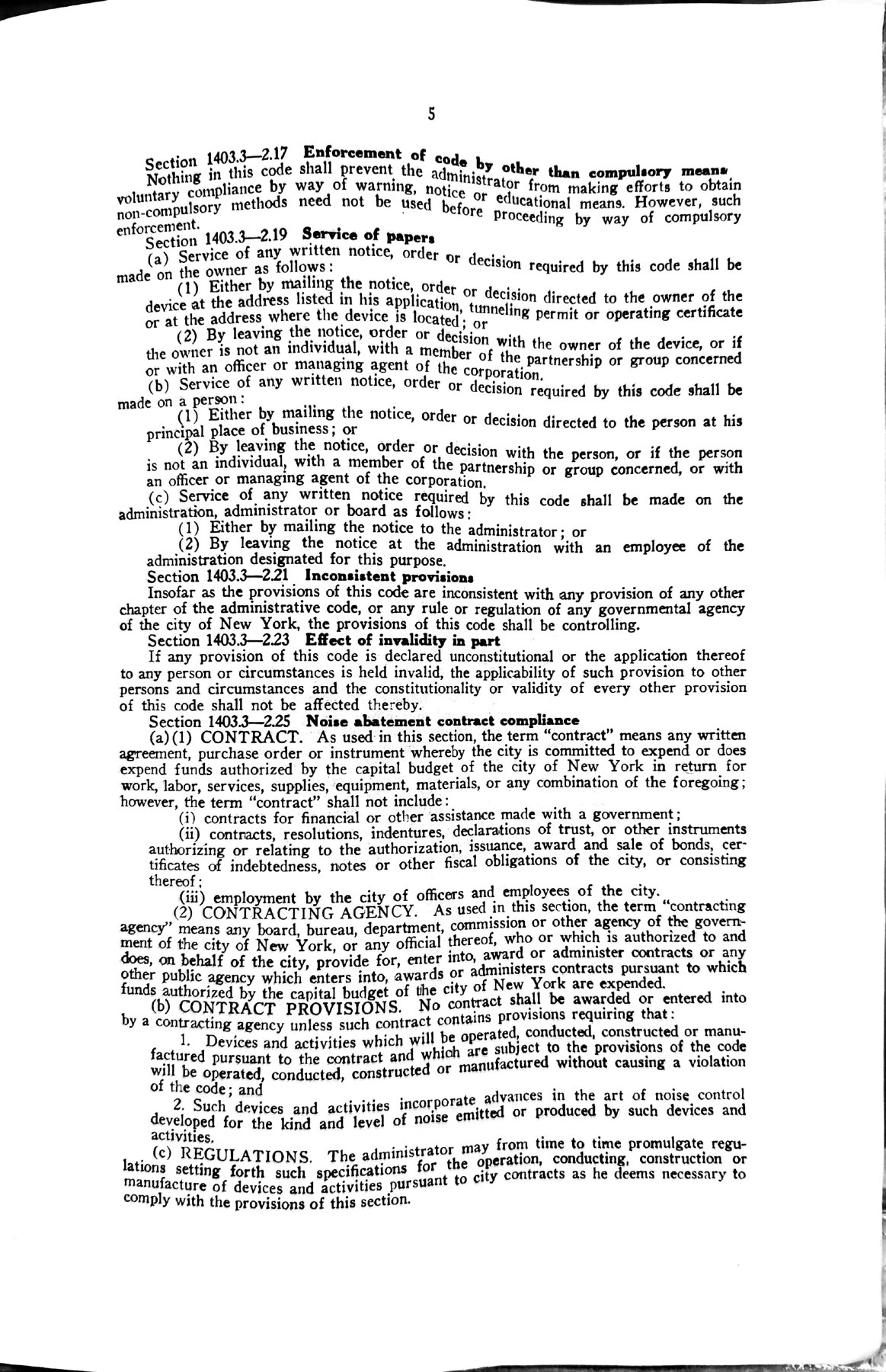
Section 1403.3—2.17 Enforcement of code by other than compulsory means
Nothing in this code shall prevent the administrator from making efforts to obtain voluntary compliance by way of warning, notice or educational means. However, such non-compulsory methods need not be used before proceeding by way of compulsory enforcement.
Section 1403.3—2.19 Service of papers
(a) Service of any written notice, order or decision required by this code shall be made on the owner as follows:
(1) Either by mailing the notice, order or decision directed to the owner of the device at the address listed in his application, tunneling permit or operating certificate or at the address where the device is located; or
(2) By leaving the notice, order or decision with the owner of the device, or if the owner is not an individual, with a member of the partnership or group concerned or with an officer or managing agent of the corporation.
(b) Service of any written notice, order or decision required by this code shall be made on a person:
(1) Either by mailing the notice, order or decision directed to the person at his principal place of business; or
(2) By leaving the notice, order or decision with the person, or if the person is not an individual, with a member of the partnership or group concerned, or with an officer or managing agent of the corporation.
(c) Service of any written notice required by this code shall be made on the administration, administrator or board as follows:
(1) Either by mailing the notice to the administrator; or
(2) By leaving the notice at the administration with an employee of the administration designated for this purpose.
Section 1403.3—2.21 Inconsistent provisions
Insofar as the provisions of this code are inconsistent with any provision of any other chapter of the administrative code, or any rule or regulation of any governmental agency of the city of New York, the provisions of this code shall be controlling.
Section 1403.3—2.23 Effect of invalidity in part
If any provision of this code is declared unconstitutional or the application thereof to any person or circumstances is held invalid, the applicability of such provision to other persons and circumstances and the constitutionality or validity of every other provision of this code shall not be affected thereby.
Section 1403.3—2.25 Noise abatement contract compliance
(a) (1) CONTRACT. As used in this section, the term “contract” means any written agreement, purchase order or instrument whereby the city is committed to expend or does expend funds authorized by the capital budget of the city of New York in return for work, labor, services, supplies, equipment, materials, or any combination of the foregoing; however, the term "contract" shall not include:
(i) contracts for financial or other assistance made with a government;
(ii) contracts, resolutions, indentures, declarations of trust, or other instruments authorizing or relating to the authorization, issuance, award and sale of bonds, certificates of indebtedness, notes or other fiscal obligations of the city, or consisting thereof;
(iii) employment by the city of officers and employees of the city.
(2) CONTRACTING AGENCY. As used in this section, the term "contracting agency" means any board, bureau, department, commission or other agency of the government of the city of New York, or any official thereof, who or which is authorized to and does, on behalf of the city, provide for, enter into, award or administer contracts or any other public agency which enters into, awards or administers contracts pursuant to which funds authorized by the capital budget of the city of New York are expended.
(b) CONTRACT PROVISIONS. No contract shall be awarded or entered into by a contracting agency unless such contract contains provisions requiring that:
1. Devices and activities which will be operated, conducted, constructed or manufactured pursuant to the contract and which are subject to the provisions of the code will be operated, conducted, constructed or manufactured without causing a violation of the code; and
2. such devices and activities incorporate advances in the art of noise control developed for the kind and level of noise emitted or produced by such devices and activities.
(c) REGULATIONS. The administrator may from time to time promulgate regulations setting forth such specifications for the operation, conducting, construction or manufacture of devices and activities pursuant to city contracts as he deems necessary to comply with the provisions of this section.
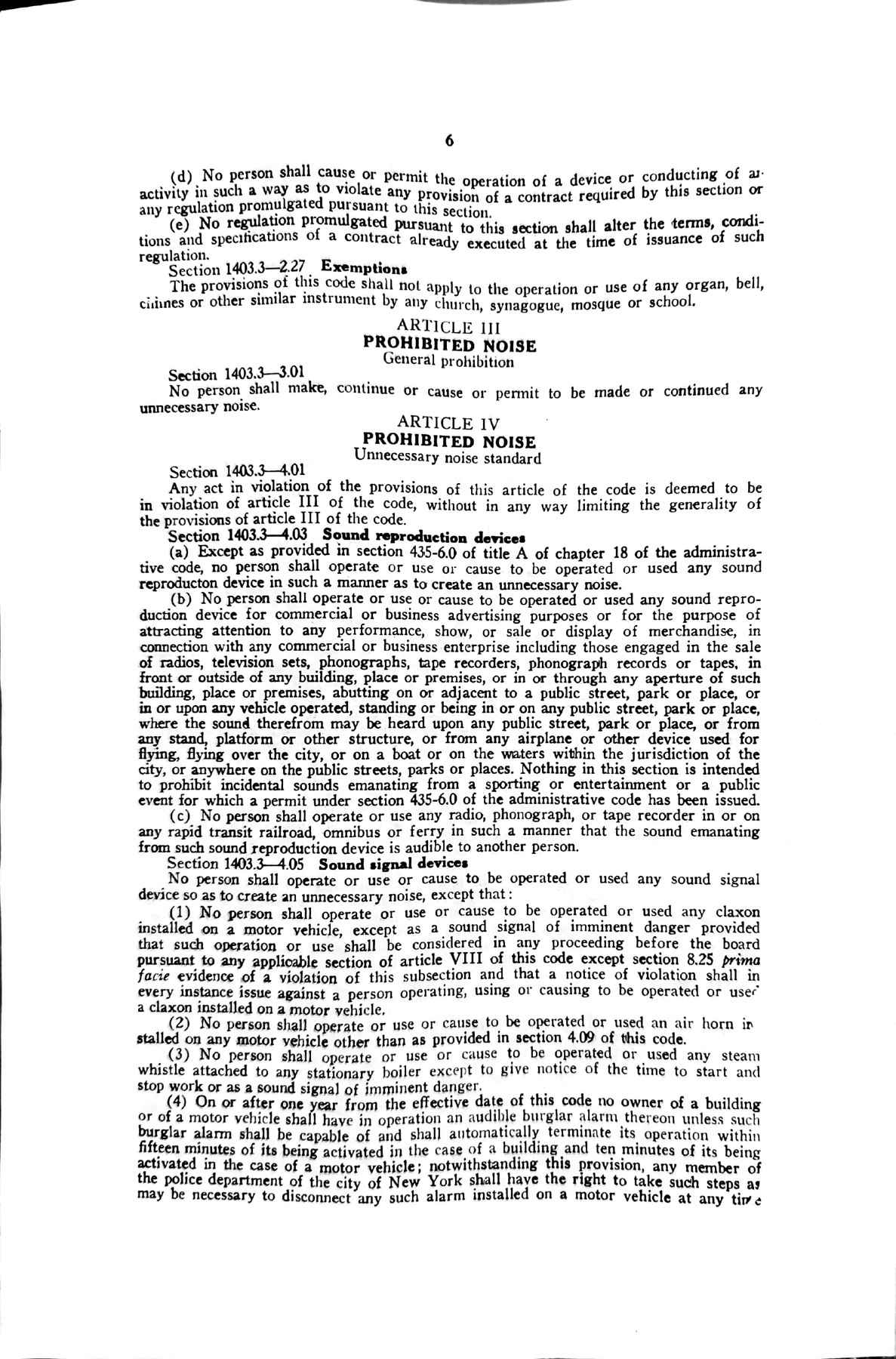
(d) No person shall cause or permit the operation of a device or conducting of an activity in such a way as to violate any provision of a contract required by this section or any regulation promulgated pursuant to this section.
(e) No regulation promulgated pursuant to this section shall alter the terms, conditions and specifications of a contract already executed at the time of issuance of such regulation.
Section 1403.3—2.27 Exemptions
The provisions of this code shall not apply to the operation or use of any organ, bell, chimes or other similar instrument by any church, synagogue, mosque or school.
ARTICLE IIIPROHIBITED NOISEGeneral prohibition
Section 1403.3—3.01
No person shall make, continue or cause or permit to be made or continued any unnecessary noise.
ARTICLE IVPROHIBITED NOISEUnnecessary noise standard
Section 1403.3—4.01
Any act in violation of the provisions of this article of the code is deemed to be in violation of article III of the code, without in any way limiting the generality of the provisions of article III of the code.
Section 1403.3—4.03 Sound reproduction devices
(a) Except as provided in section 435-6.0 of title A of chapter 18 of the administrative code, no person shall operate or use or cause to be operated or used any sound reproduction device in such a manner as to create an unnecessary noise.
(b) No person shall operate or use or cause to be operated or used any sound reproduction device for commercial or business advertising purposes or for the purpose of attracting attention to any performance, show, or sale or display of merchandise, in connection with any commercial or business enterprise including those engaged in the sale of radios, television sets, phonographs, tape recorders, phonograph records or tapes, in front or outside of any building, place or premises, or in or through any aperture of such building, place or premises, abutting on or adjacent to a public street, park or place, or in or upon any vehicle operated, standing or being in or on any public street, park or place, where the sound therefrom may be heard upon any public street, park or place, or from any stand, platform or other structure, or from any airplane or other device used for flying, flying over the city, or on a boat or on the wrøters within the jurisdiction of the city, or anywhere on the public streets, parks or places. Nothing in this section is intended to prohibit incidental sounds emanating from a sporting or entertainment or a public event for which a permit under section 435-6.0 of the administrative code has been issued.
(c) No person shall operate or use any radio, phonograph, or tape recorder in or on any rapid transit railroad, omnibus or ferry in such a manner that the sound emanating from such sound reproduction device is audible to another person.
Section 1403.3—4.05 Sound signal devices
No person shall operate or use or cause to be operated or used any sound signal device so as to create an unnecessary noise, except that:
(1) No person shall operate or use or cause to be operated or used any claxon installed on a motor vehicle, except as a sound signal of imminent danger provided that such operation or use shall be considered in any proceeding before the board pursuant to any applicable section of article VIII of this code except section 8.25 prima facie evidence of a violation of this subsection and that a notice of violation shall in every instance issue against a person operating, using or causing to be operated or used a claxon installed on a motor vehicle.
(2) No person shall operate or use or cause to be operated or used an air horn installed on any motor vehicle other than as provided in section 4.09 of this code.
(3) No person shall operate or use or cause to be operated or used any steam whistle attached to any stationary boiler except to give notice of the time to start and stop work or as a sound signal of imminent danger.
(4) On or after one year from the effective date of this code no owner of a building or of a motor vehicle shall have in operation an audible burglar alarm thereon unless such burglar alarm shall be capable of and shall automatically terminate its operation within fifteen minutes of its being activated in the case of a building and ten minutes of its being activated in the case of a motor vehicle; notwithstanding this provision, any member of the police department of the city of New York shall have the right to take such steps as may be necessary to disconnect any such alarm installed on a motor vehicle at any time
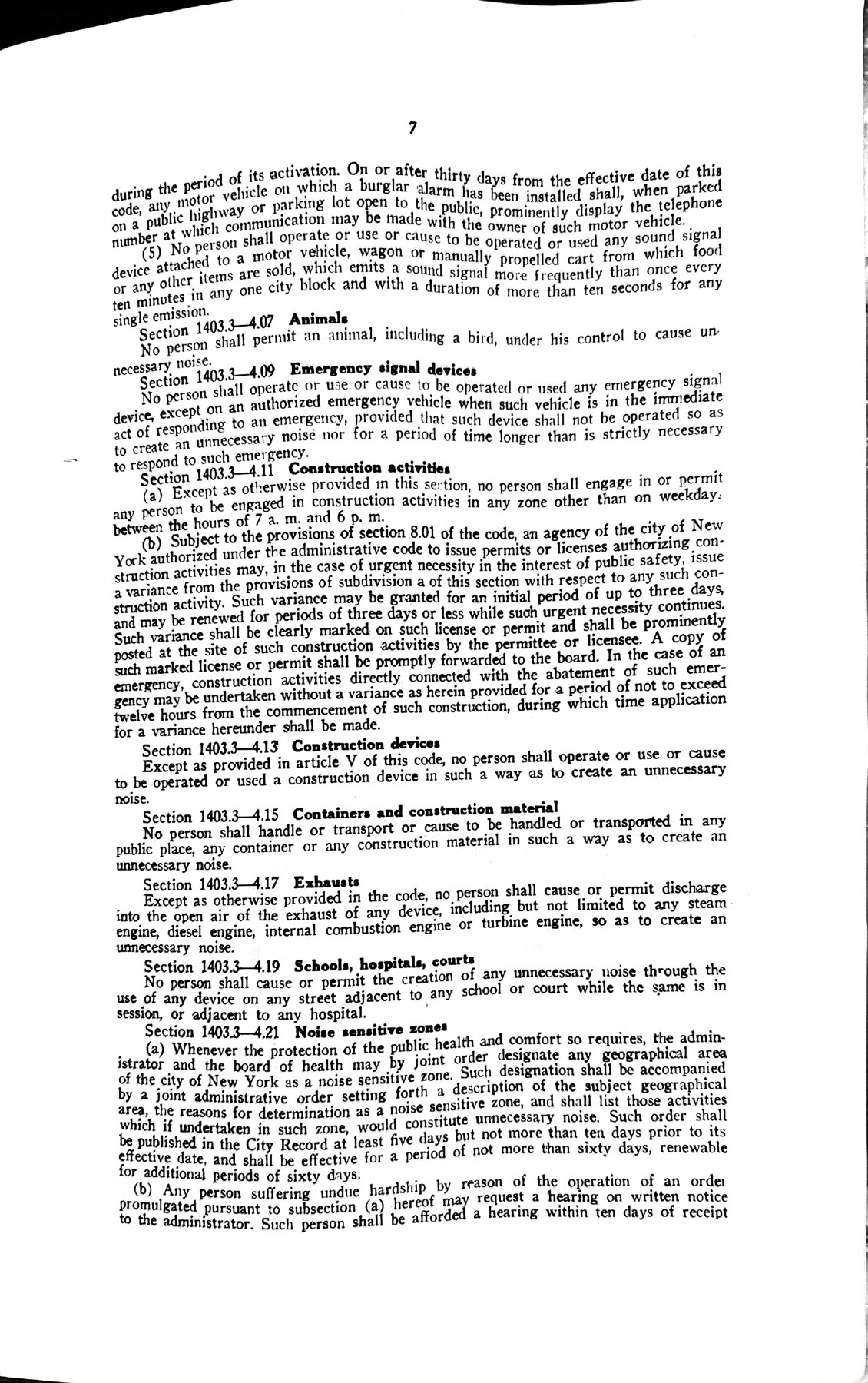
during the period of its activation. On or after thirty days from the effective date of this code, any motor vehicle on which a burglar alarm has been installed shall, when parked on a public highway or parking lot open to the public, prominently display the telephone number at which communication may be made with the owner of such motor vehicle.
(5) No person shall operate or use or cause to be operated or used any sound signal device attached to a motor vehicle, wagon or manually propelled cart from which food or any other items are sold, which emits a sound signal more frequently than once every ten minutes in any one city block and with a duration of more than ten seconds for any single emission.
Section 1403.3—4.07 Animals
No person shall permit an animal, including a bird, under his control to cause unnecessary noise.
Section 1403.3—4.09 Emergency signal devices
No person shall operate or use or cause to be operated or used any emergency signal device, except on an authorized emergency vehicle when such vehicle is in the immediate act of responding to an emergency, provided that such device shall not be operated so as to create an unnecessary noise nor for a period of time longer than is strictly necessary to respond to such emergency.
Section 1403.3—4.11 Construction activities
(a) Except as otherwise provided in this section, no person shall engage in or permit any person to be engaged in construction activities in any zone other than on weekdays between the hours of 7 a. m. and 6 p. m.
(b) Subject to the provisions of section 8.01 of the code, an agency of the city of New York authorized under the administrative code to issue permits or licenses authorizing construction activities may, in the case of urgent necessity in the interest of public safety, issue a variance from the provisions of subdivision a of this section with respect to any such construction activity. such variance may be granted for an initial period of up to three days, and may be renewed for periods of three days or less while such urgent necessity continues. Such variance shall be clearly marked on such license or permit and shall be prominently posted at the site of such construction activities by the permittee or licensee. A copy of such marked license or permit shall be promptly forwarded to the board. In the case of an emergency, construction activities directly connected with the abatement of such emergency may be undertaken without a variance as herein provided for a period of not to exceed twelve hours from the commencement of such construction, during which time application for a variance hereunder shall be made.
Section 1403.3—4.13 Construction devices
Except as provided in article V of this code, no person shall operate or use or cause to be operated or used a construction device in such a way as to create an unnecessary noise.
Section 1403.3—4.15 Containers and construction material
No person shall handle or transport or cause to be handled or transported in any public place, any container or any construction material in such a way as to create an unnecessary noise.
Section 1403.3—4.17 Exhausts
Except as otherwise provided in the code, no person shall cause or permit discharge into the open air of the exhaust of any device, including but not limited to any steam engine, diesel engine, internal combustion engine or turbine engine, so as to create an unnecessary noise.
Section 1403.3—4.19 Schools, hospitals, courts
No person shall cause or permit the creation of any unnecessary noise through the use of any device on any street adjacent to any school or court while the same is in session, or adjacent to any hospital.
Section 1403.3—4.21 Noise sensitive zones
(a) Whenever the protection of the public health and comfort so requires, the administrator and the board of health may by joint order designate any geographical area of the city of New York as a noise sensitive zone. such designation shall be accompanied by a joint administrative order setting forth a description of the subject geographical area, the reasons for determination as a noise sensitive zone, and shall list those activities which if undertaken in such zone, would constitute unnecessary noise. such order shall be published in the City Record at least five days but not more than ten days prior to its effective date, and shall be effective for a period of not more than sixty days, renewable for additional periods of sixty days.
(b) Any person suffering undue hardship by reason of the operation of an order promulgated pursuant to subsection (a) hereof may request a hearing on written notice to the administrator. Such person shall be afforded a hearing within ten days of receipt
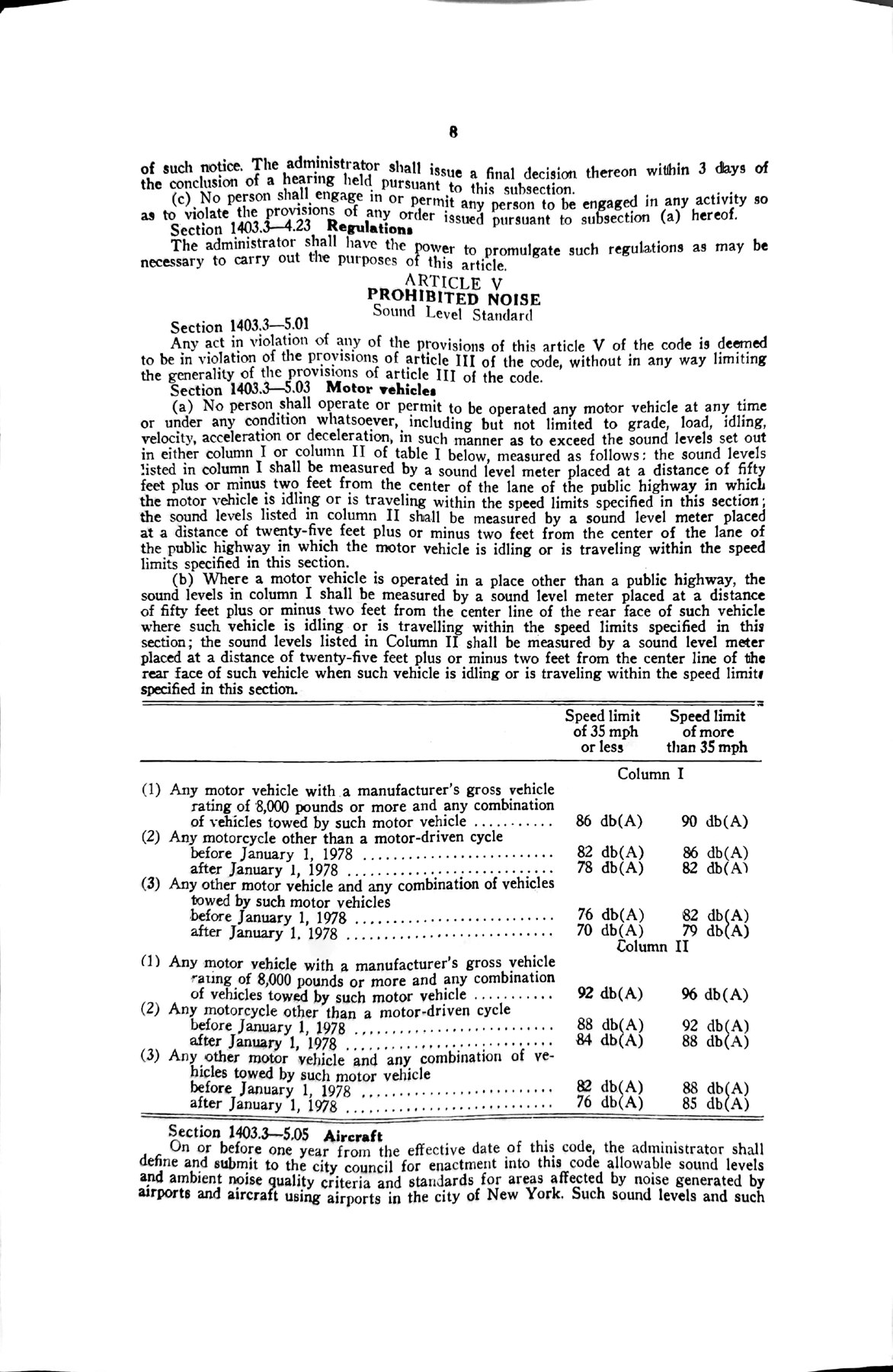
of such notice. The administrator shall issue a final decision thereon within 3 days of the conclusion of a hearing held pursuant to this subsection.
(c) No person shall engage in or permit any person to be engaged in any activity so as to violate the provisions of any order issued pursuant to subsection (a) hereof.
Section 1403.3—4.23 Regulations
The administrator shall have the power to promulgate such regulations as may be necessary to carry out the purposes of this article.
ARTICLE VPROHIBITED NOISESound Level Standard
Section 1403.3—5.01
Any act in violation of any of the provisions of this article V of the code is deemed to be in violation of the provisions of article III of the code, without in any way limiting the generality of the provisions of article III of the code.
Section 1403.3—5.03 Motor vehicles
(a) No person shall operate or permit to be operated any motor vehicle at any time or under any condition whatsoever, including but not limited to grade, load, idling, velocity, acceleration or deceleration, in such manner as to exceed the sound levels set out in either column I or column II of table I below, measured as follows: the sound levels listed in column I shall be measured by a sound level meter placed at a distance of fifty feet plus or minus two feet from the center of the lane of the public highway in which the motor vehicle is idling or is traveling within the speed limits specified in this section; the sound levels listed in column II shall be measured by a sound level meter placed at a distance of twenty-five feet plus or minus two feet from the center of the lane of the public highway in which the motor vehicle is idling or is traveling within the speed limits specified in this section.
(b) Where a motor vehicle is operated in a place other than a public highway, the sound levels in column I shall be measured by a sound level meter placed at a distance of fifty feet plus or minus two feet from the center line of the rear face of such vehicle where such vehicle is idling or is travelling within the speed limits specified in this section; the sound levels listed in Column II shall be measured by a sound level meter placed at a distance of twenty-five feet plus or minus two feet from the center line of the rear face of such vehicle when such vehicle is idling or is traveling within the speed limits specified in this section.
| Motor vehicle | Speed limit of 35 mph or less | Speed limit of more than 35 mph |
|---|---|---|
| Column I | ||
| (1) Any motor vehicle with a manufacturer’s gross vehicle rating of 8,000 pounds or more and any combination of vehicles towed by such motor vehicle | 86 db(A) | 90 db(A) |
| (2) Any motorcycle other than a motor-driven cycle — before January 1, 1978 | 82 db(A) | 86 db(A) |
| after January 1, 1978 | 78 db(A) | 82 db(A) |
| (3) Any other motor vehicle and any combination of vehicles towed by such motor vehicles — before January 1, 1978 | 76 db(A) | 82 db(A) |
| after January 1, 1978 | 70 db(A) | 79 db(A) |
| Column II | ||
| (1) Any motor vehicle with a manufacturer’s gross vehicle rating of 8,000 pounds or more and any combination of vehicles towed by such motor vehicle | 92 db(A) | 96 db(A) |
| (2) Any motorcycle other than a motor-driven cycle — before January 1, 1978 | 88 db(A) | 92 db(A) |
| after January 1, 1978 | 84 db(A) | 88 db(A) |
| (3) Any other motor vehicle and any combination of vehicles towed by such motor vehicle — before January 1, 1978 | 82 db(A) | 88 db(A) |
| after January 1, 1978 | 76 db(A) | 85 db(A) |
Section 1403.3—5.05 Aircraft
On or before one year from the effective date of this code, the administrator shall define and submit to the city council for enactment into this code allowable sound levels and ambient noise quality criteria and standards for areas affected by noise generated by airports and aircraft using airports in the city of New York. such sound levels and such
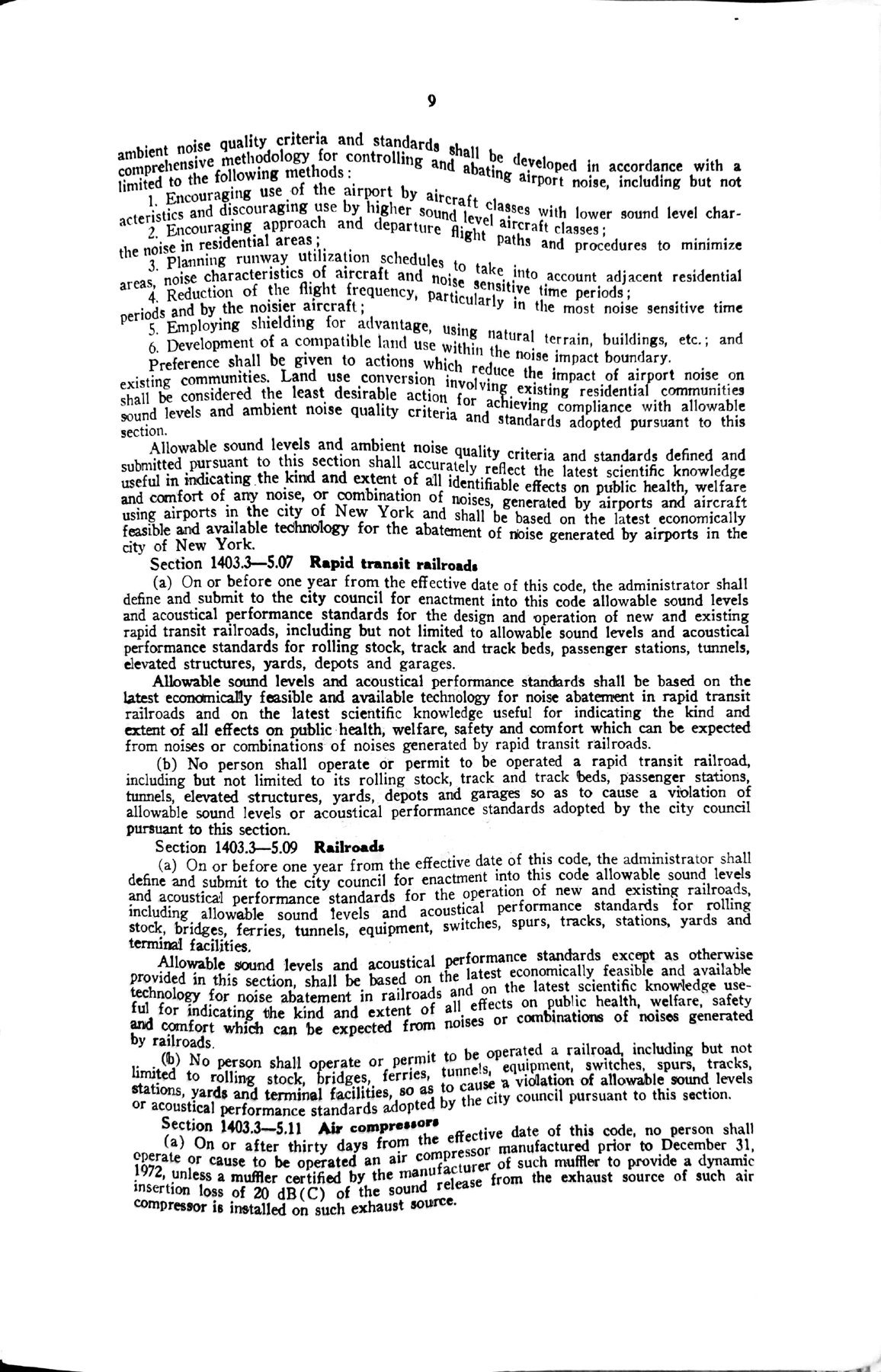
ambient noise quality criteria and standards shall be developed in accordance with a comprehensive methodology for controlling and abating airport noise, including but not limited to the following methods:
1. Encouraging use of the airport by aircraft classes with lower sound level characteristics and discouraging use by higher sound level aircraft classes;
2. Encouraging approach and departure flight paths and procedures to minimize the noise in residential areas;
3. Planning runway utilization schedules to take into account adjacent residential areas, noise characteristics of aircraft and noise sensitive time periods;
4. Reduction of the flight frequency, particularly in the most noise sensitive time periods and by the noisier aircraft;
5. Employing shielding for advantage, using natural terrain, buildings, etc.; and
6. Development of a compatible land use within the noise impact boundary.
Preference shall be given to actions which reduce the impact of airport noise on existing communities. Land use conversion involving existing residential communities shall be considered the least desirable action for achieving compliance with allowable sound levels and ambient noise quality criteria and standards adopted pursuant to this section.
Allowable sound levels and ambient noise quality criteria and standards defined and submitted pursuant to this section shall accurately reflect the latest scientific knowledge useful in indicating the kind and extent of all identifiable effects on public health, welfare and comfort of any noise, or combination of noises, generated by airports and aircraft using airports in the city of New York and shall be based on the latest economically feasible and available technology for the abatement of noise generated by airports in the city of New York.
Section 1403.3—5.07 Rapid transit railroads
(a) On or before one year from the effective date of this code, the administrator shall define and submit to the city council for enactment into this code allowable sound levels and acoustical performance standards for the design and operation of new and existing rapid transit railroads, including but not limited to allowable sound levels and acoustical performance standards for rolling stock, track and track beds, passenger stations, tunnels, elevated structures, yards, depots and garages.
Allowable sound levels and acoustical performance standards shall be based on the latest economically feasible and available technology for noise abatement in rapid transit railroads and on the latest scientific knowledge useful for indicating the kind and extent of all effects on public health, welfare, safety and comfort which can be expected from noises or combinations of noises generated by rapid transit railroads.
(b) No person shall operate or permit to be operated a rapid transit railroad, including but not limited to its rolling stock, track and track beds, passenger stations, tunnels, elevated structures, yards, depots and garages so as to cause a violation of allowable sound levels or acoustical performance standards adopted by the city council pursuant to this section.
Section 1403.3—5.09 Railroads
(a) On or before one year from the effective date of this code, the administrator shall define and submit to the city council for enactment into this code allowable sound levels and acoustical performance standards for the operation of new and existing railroads, including allowable sound levels and acoustical performance standards for rolling stock, bridges, ferries, tunnels, equipment, switches, spurs, tracks, stations, yards and terminal facilities.
Allowable sound levels and acoustical performance standards except as otherwise provided in this section, shall be based on the latest economically feasible and available technology for noise abatement in railroads and on the latest scientific knowledge useful for indicating the kind and extent of all effects on public health, welfare, safety and comfort which can be expected from noises or combinations of noises generated by railroads.
(b) No person shall operate or permit to be operated a railroad, including but not limited to rolling stock, bridges, ferries, tunnels, equipment, switches, spurs, tracks, stations, yards and terminal facilities, so as to cause a violation of allowable sound levels or acoustical performance standards adopted by the city council pursuant to this section.
Section 1403.3—5.11 Air compressors
(a) On or after thirty days from the effective date of this code, no person shall operate or cause to be operated an air compressor manufactured prior to December 31, 1972, unless a muffler certified by the manufacturer of such muffler to provide a dynamic insertion loss of 20 dB(C) of the sound release from the exhaust source of such air compressor is installed on such exhaust source.
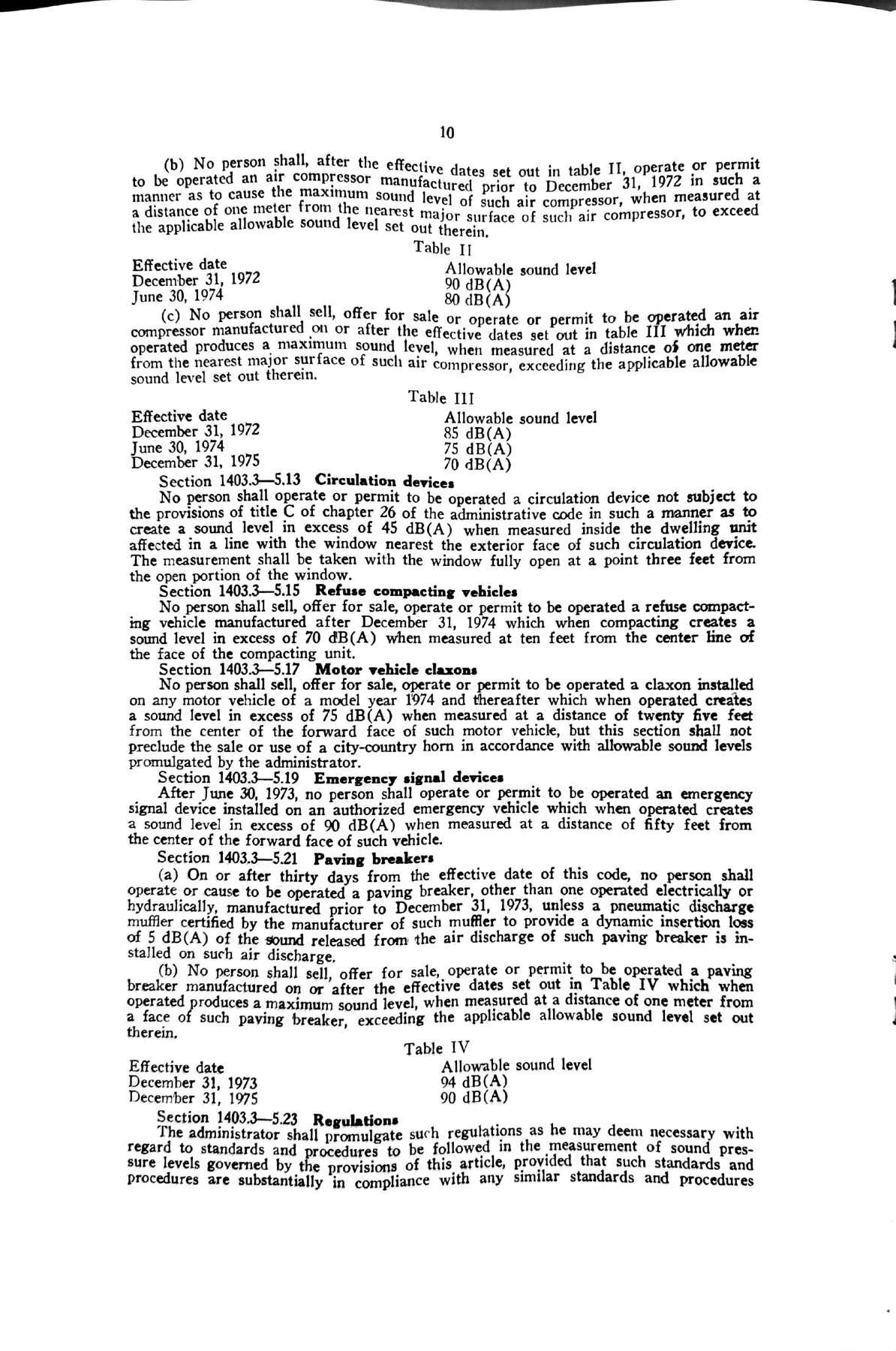
(b) No person shall, after the effective dates set out in table II, operate or permit to be operated an air compressor manufactured prior to December 31, 1972 in such a manner as to cause the maximum sound level of such air compressor, when measured at a distance of one meter from the nearest major surface of such air compressor, to exceed the applicable allowable sound level set out therein.
| Effective date | Allowable sound level |
|---|---|
| December 31, 1972 | 90 dB(A) |
| June 30, 1974 | 80 dB(A) |
(c) No person shall sell, offer for sale or operate or permit to be operated an air compressor manufactured on or after the effective dates set out in table III which when operated produces a maximum sound level, when measured at a distance of one meter from the nearest major surface of such air compressor, exceeding the applicable allowable sound level set out therein.
| Effective date | Allowable sound level |
|---|---|
| December 31, 1972 | 85 dB(A) |
| June 30, 1974 | 75 dB(A) |
| December 31, 1975 | 70 dB(A) |
Section 1403.3—5.13 Circulation devices
No person shall operate or permit to be operated a circulation device not subject to the provisions of title C of chapter 26 of the administrative code in such a manner as to create a sound level in excess of 45 dB(A) when measured inside the dwelling unit affected in a line with the window nearest the exterior face of such circulation device. The measurement shall be taken with the window fully open at a point three feet from the open portion of the window.
Section 1403.3—5.15 Refuse compacting vehicles
No person shall sell, offer for sale, operate or permit to be operated a refuse compacting vehicle manufactured after December 31, 1974 which when compacting creates a sound level in excess of 70 dB(A) when measured at ten feet from the center line of the face of the compacting unit.
Section 1403.3—5.17 Motor vehicle claxons
No person shall sell, offer for sale, operate or permit to be operated a claxon installed on any motor vehicle of a model year 1974 and thereafter which when operated creates a sound level in excess of 75 dB(A) when measured at a distance of twenty five feet from the center of the forward face of such motor vehicle, but this section shall not preclude the sale or use of a city-country horn in accordance with allowable sound levels promulgated by the administrator.
Section 1403.3—5.19 Emergency signal devices
After June 30, 1973, no person shall operate or permit to be operated an emergency signal device installed on an authorized emergency vehicle which when operated creates a sound level in excess of 90 dB(A) when measured at a distance of fifty feet from the center of the forward face of such vehicle.
Section 1403.3—5.21 Paving breakers
(a) On or after thirty days from the effective date of this code, no person shall operate or cause to be operated a paving breaker, other than one operated electrically or hydraulically, manufactured prior to December 31, 1973, unless a pneumatic discharge muffler certified by the manufacturer of such muffler to provide a dynamic insertion loss of 5 dB(A) of the sound released from the air discharge of such paving breaker is installed on such air discharge.
(b) No person shall sell, offer for sale, operate or permit to be operated a paving breaker manufactured on or after the effective dates set out in Table IV which when operated produces a maximum sound level, when measured at a distance of one meter from a face of such paving breaker, exceeding the applicable allowable sound level set out therein.
| Effective date | Allowable sound level |
|---|---|
| December 31, 1973 | 94 dB(A) |
| December 31, 1975 | 90 dB(A) |
Section 1403.3—5.23 Regulations
The administrator shall promulgate such regulations as he may deem necessary with regard to standards and procedures to be followed in the measurement of sound pressure levels governed by the provisions of this article, provided that such standards and procedures are substantially in compliance with any similar standards and procedures
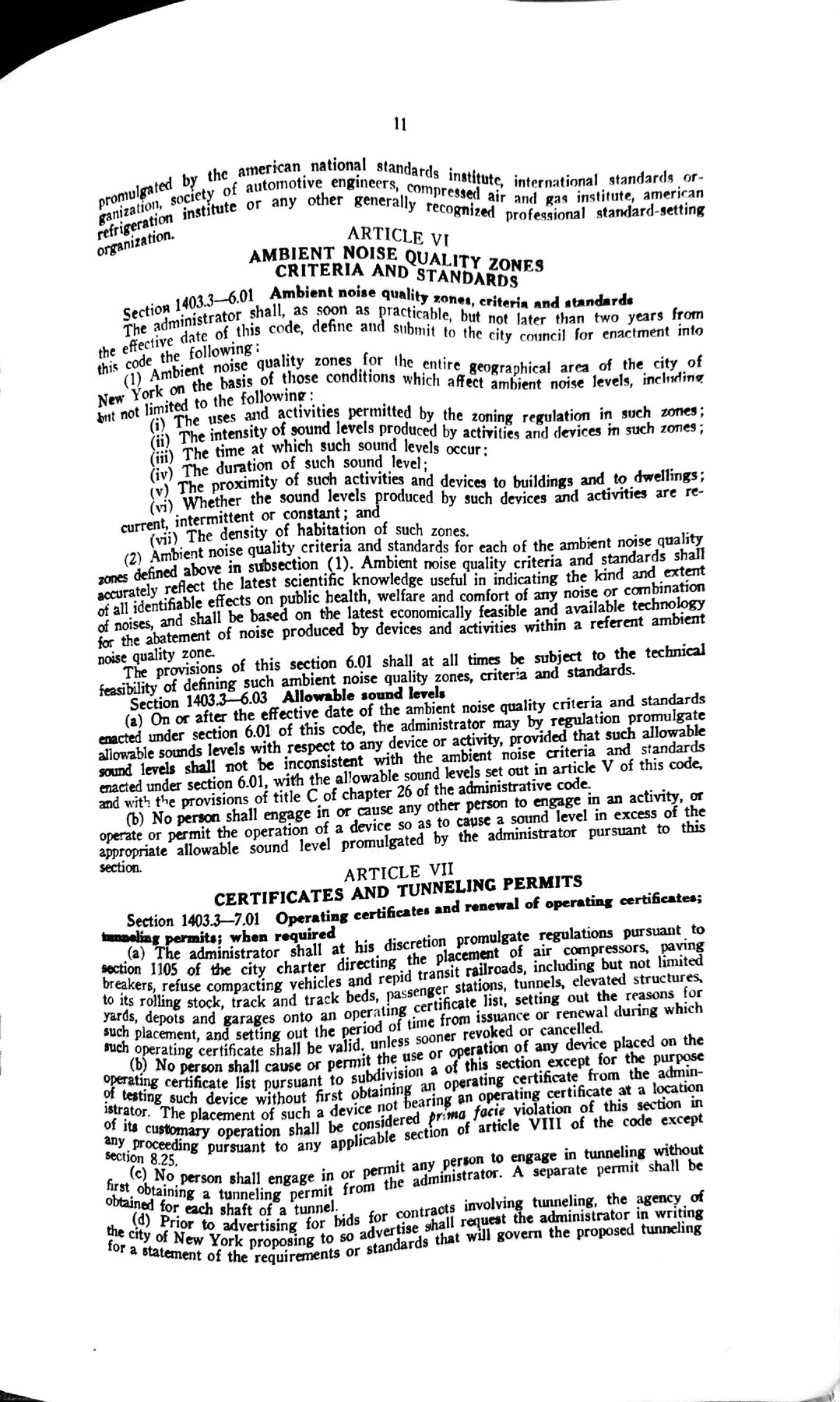
promulgated by the american national standards institute, international standards organization, society of automotive engineers, compressed air and gas institute, american refrigeration institute or any other generally recognized professional standard-setting organization.
ARTICLE VIAMBIENT NOISE QUALITY ZONES CRITERIA AND STANDARDS
Section 1403.3—6.01 Ambient noise quality zones, criteria and standards
The administrator shall, as soon as practicable, but not later than two years from the effective date of this code, define and submit to the city council for enactment into this code the following:
(1) Ambient noise quality zones for the entire geographical area of the city of New York on the basis of those conditions which affect ambient noise levels, including but not limited to the following:
(i) The uses and activities permitted by the zoning regulation in such zones;
(ii) The intensity of sound levels produced by activities and devices in such zones;
(iii) The time at which such sound levels occur;
(iv) The duration of such sound level;
(v) The proximity of such activities and devices to buildings and to dwellings;
(vi) Whether the sound levels produced by such devices and activities are recurrent, intermittent or constant; and
(vii) The density of habitation of such zones.
(2) Ambient noise quality criteria and standards for each of the ambient noise quality zones defined above in subsection (1). Ambient noise quality criteria and standards shall accurately reflect the latest scientific knowledge useful in indicating the kind and extent of all identifiable effects on public health, welfare and comfort of any noise or combination of noises, and shall be based on the latest economically feasible and available technology for the abatement of noise produced by devices and activities within a referent ambient noise quality zone.
The provisions of this section 6.01 shall at all times be subject to the technical feasibility of defining such ambient noise quality zones, criteria and standards.
Section 1403.3—6.03 Allowable sound levels
(a) On or after the effective date of the ambient noise quality criteria and standards enacted under section 6.01 of this code, the administrator may by regulation promulgate allowable sounds levels with respect to any device or activity, provided that such allowable sound levels shall not be inconsistent with the ambient noise criteria and standards enacted under section 6.01, with the allowable sound levels set out in article V of this code, and with the provisions of title C of chapter 26 of the administrative code.
(b) No person shall engage in or cause any other person to engage in an activity, or operate or permit the operation of a device so as to cause a sound level in excess of the appropriate allowable sound level promulgated by the administrator pursuant to this section.
ARTICLE VIICERTIFICATES AND TUNNELING PERMITS
Section 1403.3—7.01 Operating certificates and renewal of operating certificates; tunneling permits; when required
(a) The administrator shall at his discretion promulgate regulations pursuant to section 1105 of the city charter directing the placement of air compressors, paving breakers, refuse compacting vehicles and repid transit railroads, including but not limited to its rolling stock, track and track beds, passenger stations, tunnels, elevated structures, yards, depots and garages onto an operating certificate list, setting out the reasons for such placement, and setting out the period of time from issuance or renewal during which such operating certificate shall be valid, unless sooner revoked or cancelled.
(b) No person shall cause or permit the use or operation of any device placed on the operating certificate list pursuant to subdivision a of this section except for the purpose of testing such device without first obtaining an operating certificate from the administrator. The placement of such a device not bearing an operating certificate at a location of its customary operation shall be considered prima facie violation of this section in any proceeding pursuant to any applicable section of article VIII of the code except section 8.25.
(c) No person shall engage in or permit any person to engage in tunneling without first Obtaining a tunneling permit from the administrator. A separate permit shall be obtained for each shaft of a tunnel.
(d) Prior to advertising for bids for contracts involving tunneling, the agency of the city of New York proposing to so advertise shall request the administrator in writing for a statement of the requirements or standards that will govern the proposed tunneling
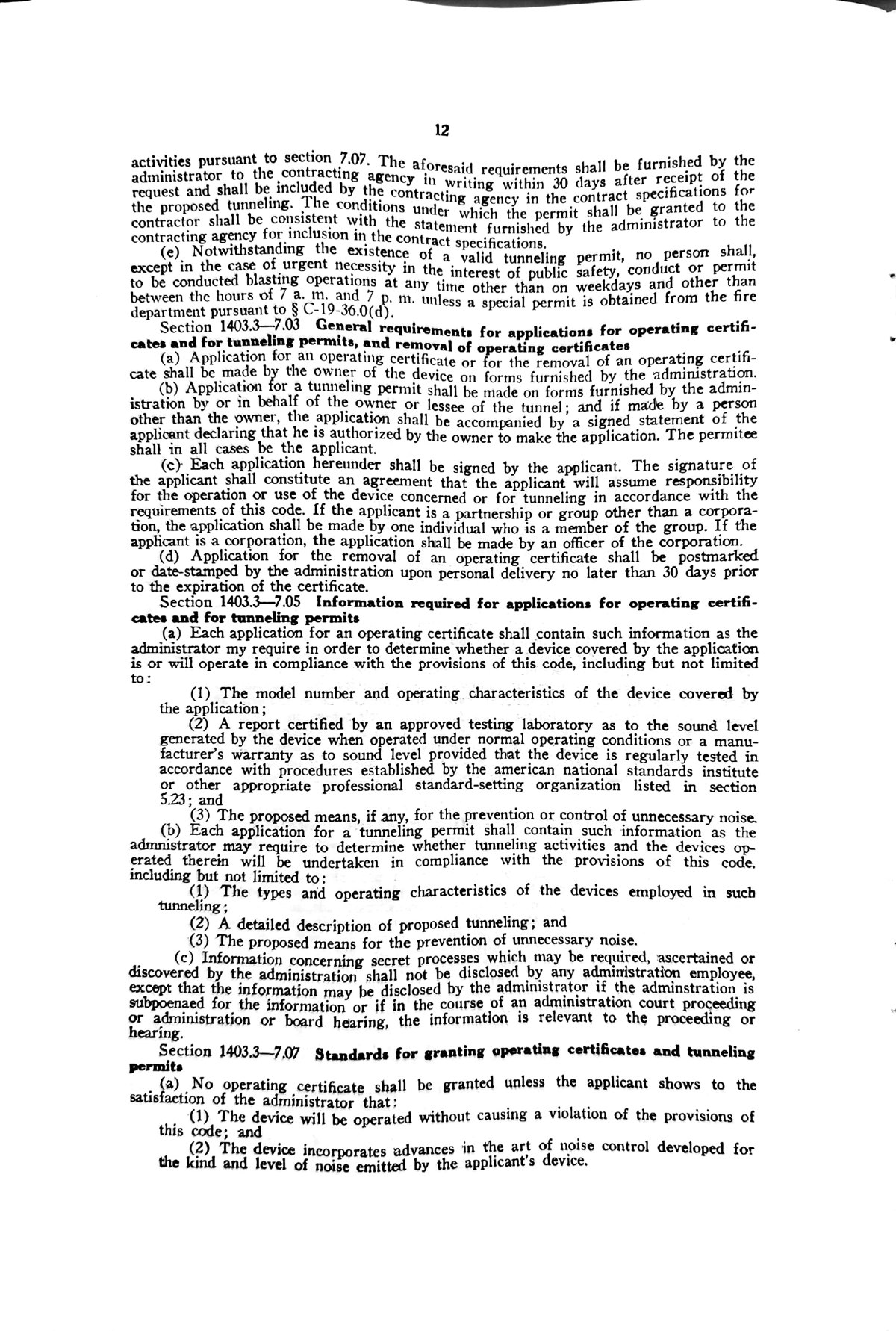
activities pursuant to section 7.07. The aforesaid requirements shall be furnished by the administrator to the contracting agency in writing within 30 days after receipt of the request and shall be included by the contracting agency in the contract specifications for the proposed tunneling. The conditions under which the permit shall be granted to the contractor shall be consistent with the statement furnished by the administrator to the contracting agency for inclusion in the contract specifications.
(e) Notwithstanding the existence of a valid tunneling permit, no person shall, except in the case of urgent necessity in the interest of public safety, conduct or permit to be conducted blasting operations at any time other than on weekdays and other than between the hours of 7 a. m. and 7 p. m. unless a special permit is obtained from the fire department pursuant to § C-19-36.0(d).
Section 1403.3—7.03 General requirements for applications for operating certificates and for tunneling permits, and removal of operating certificates
(a) Application for an operating certificate or for the removal of an operating certificate shall be made by the owner of the device on forms furnished by the administration.
(b) Application for a tunneling permit shall be made on forms furnished by the administration by or in behalf of the owner or lessee of the tunnel; and if made by a person other than the owner, the application shall be accompanied by a signed statement of the applicant declaring that he is authorized by the owner to make the application. The permitee shall in all cases be the applicant.
(c) Each application hereunder shall be signed by the applicant. The signature of the applicant shall constitute an agreement that the applicant will assume responsibility for the operation or use of the device concerned or for tunneling in accordance with the requirements of this code. If the applicant is a partnership or group other than a corporation, the application shall be made by one individual who is a member of the group. If the applicant is a corporation, the application shall be made by an officer of the corporation.
(d) Application for the removal of an operating certificate shall be postmarked or date-stamped by the administration upon personal delivery no later than 30 days prior to the expiration of the certificate.
Section 1403.3—7.05 Information required for applications for operating certificates and for tunneling permits
(a) Each application for an operating certificate shall contain such information as the administrator my require in order to determine whether a device covered by the application is or will operate in compliance with the provisions of this code, including but not limited to:
(1) The model number and operating characteristics of the device covered by the application;
(2) A report certified by an approved testing laboratory as to the sound level generated by the device when operated under normal operating conditions or a manufacturer's warranty as to sound level provided that the device is regularly tested in accordance with procedures established by the american national standards institute or other appropriate professional standard-setting organization listed in section
5.23; and
(3) The proposed means, if any, for the prevention or control of unnecessary noise.
(b) Each application for a tunneling permit shall contain such information as the administrator may require to determine whether tunneling activities and the devices operated therein will be undertaken in compliance with the provisions of this code, including but not limited to:
(1) The types and operating characteristics of the devices employed in such tunneling;
(2) A detailed description of proposed tunneling; and
(3) The proposed means for the prevention of unnecessary noise.
(c) Information concerning secret processes which may be required, ascertained or discovered by the administration shall not be disclosed by any administration employee, except that the information may be disclosed by the administrator if the adminstration is subpoenaed for the information or if in the course of an administration court proceeding or administration or board hearing, the information is relevant to the proceeding or hearing.
Section 1403.3—7.07 Standards for granting operating certificates and tunneling permits
(a) No operating certificate shall be granted unless the applicant shows to the satisfaction of the administrator that:
(1) The device will be operated without causing a violation of the provisions of this code; and
(2) The device incorporates advances in the art of noise control developed for the kind and level of noise emitted by the applicant's device.
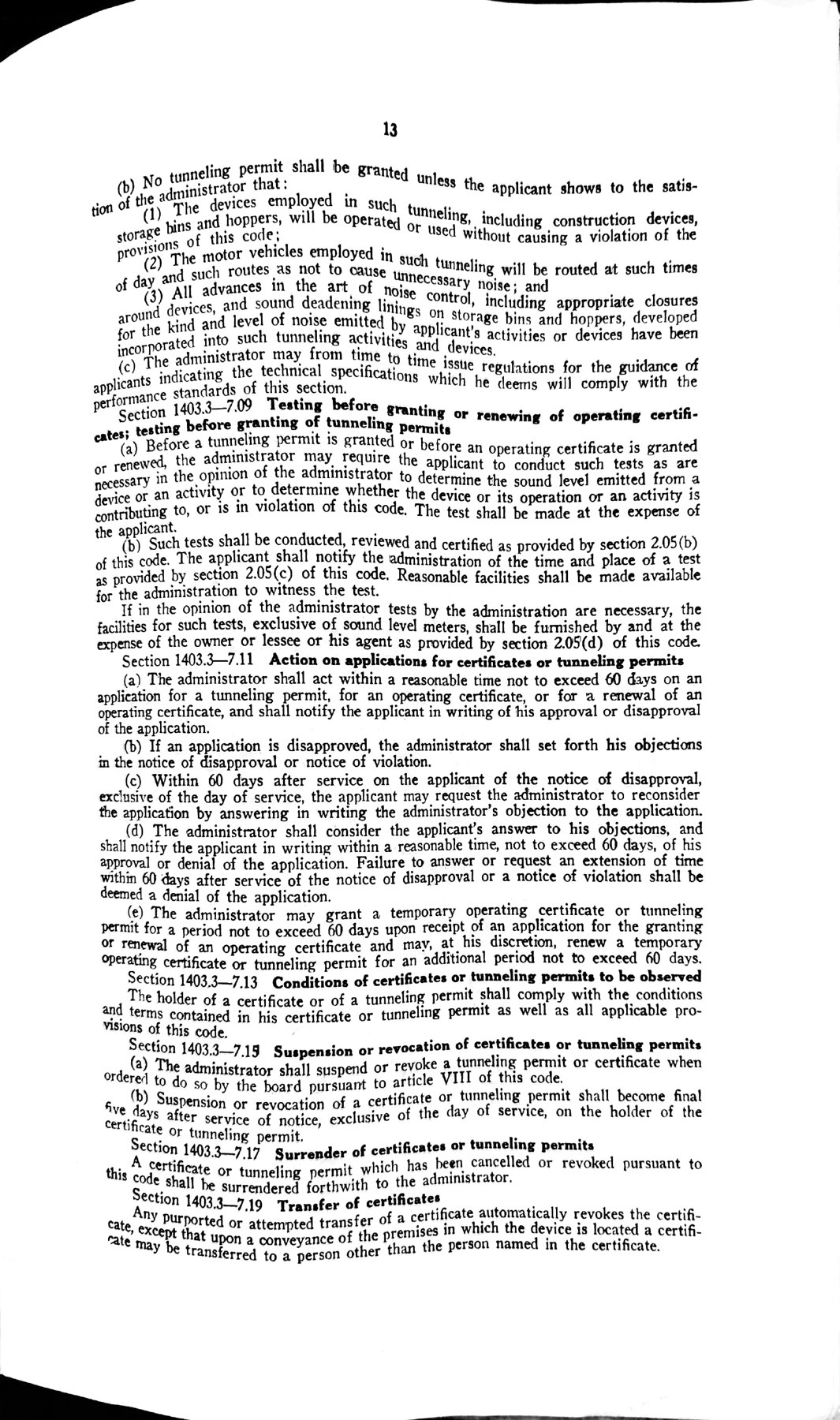
(b) No tunneling permit shall be granted unless the applicant shows to the satisfaction of the administrator that:
(1) The devices employed in such tunneling, including construction devices, storage bins and hoppers, will be operated or used without causing a violation of the provisions of this code;
(2) The motor vehicles employed in such tunneling will be routed at such times of day and such routes as not to cause unnecessary noise; and
(3) All advances in the art of noise control, including appropriate closures around devices, and sound deadening linings on storage bins and hoppers, developed for the kind and level of noise emitted by applicant's activities or devices have been incorporated into such tunneling activities and devices.
(c) The administrator may from time to time issue regulations for the guidance of applicants indicating the technical specifications which he deems will comply with the performance standards of this section.
Section 1403.3—7.09 Testing before granting or renewing of operating certificates; testing before granting of tunneling permits
(a) Before a tunneling permit is granted or before an operating certificate is granted or renewed, the administrator may require the applicant to conduct such tests as are necessary in the opinion of the administrator to determine the sound level emitted from a device or an activity or to determine whether the device or its operation or an activity is contributing to, or is in violation of this code. The test shall be made at the expense of the applicant.
(b) such tests shall be conducted, reviewed and certified as provided by section 2.05 (b) of this code. The applicant shall notify the administration of the time and place of a test as provided by section 2.05 (c) of this code. Reasonable facilities shall be made available for the administration to witness the test.
If in the opinion of the administrator tests by the administration are necessary, the facilities for such tests, exclusive of sound level meters, shall be furnished by and at the expense of the owner or lessee or his agent as provided by section 2.05(d) of this code.
Section 1403.3—7.11 Action on applications for certificates or tunneling permits
(a) The administrator shall act within a reasonable time not to exceed 60 days on an application for a tunneling permit, for an operating certificate, or for a renewal of an operating certificate, and shall notify the applicant in writing of his approval or disapproval of the application.
(b) If an application is disapproved, the administrator shall set forth his objections in the notice of disapproval or notice of violation.
(c) Within 60 days after service on the applicant of the notice of disapproval, exclusive of the day of service, the applicant may request the administrator to reconsider the application by answering in writing the administrator's objection to the application.
(d) The administrator shall consider the applicant's answer to his objections, and shall notify the applicant in writing within a reasonable time, not to exceed 60 days, of his approval or denial of the application. Failure to answer or request an extension of time within 60 days after service of the notice of disapproval or a notice of violation shall be deemed a denial of the application.
(e) The administrator may grant a temporary operating certificate or tunneling permit for a period not to exceed 60 days upon receipt of an application for the granting or renewal of an operating certificate and may, at his discretion, renew a temporary operating certificate or tunneling permit for an additional period not to exceed 60 days.
Section 1403.3—7.13 Conditions of certificates or tunneling permits to be observed
The holder of a certificate or of a tunneling permit shall comply with the conditions and terms contained in his certificate or tunneling permit as well as all applicable provisions of this code.
Section 1403.3—7.15 Suspension or revocation of certificates or tunneling permits
(a) The administrator shall suspend or revoke a tunneling permit or certificate when ordered to do so by the board pursuant to article VIII of this code.
(b) Suspension or revocation of a certificate or tunneling permit shall become final five days after service of notice, exclusive of the day of service, on the holder of the certificate or tunneling permit.
Section 1403.3—7.17 Surrender of certificates or tunneling permits
A certificate or tunneling permit which has been cancelled or revoked pursuant to this code shall be surrendered forthwith to the administrator.
Section 1403.3—7.19 Transfer of certificates
Any purported or attempted transfer of a certificate automatically revokes the certificate, except that upon a conveyance of the premises in which the device is located a certificate may be transferred to a person other than the person named in the certificate.
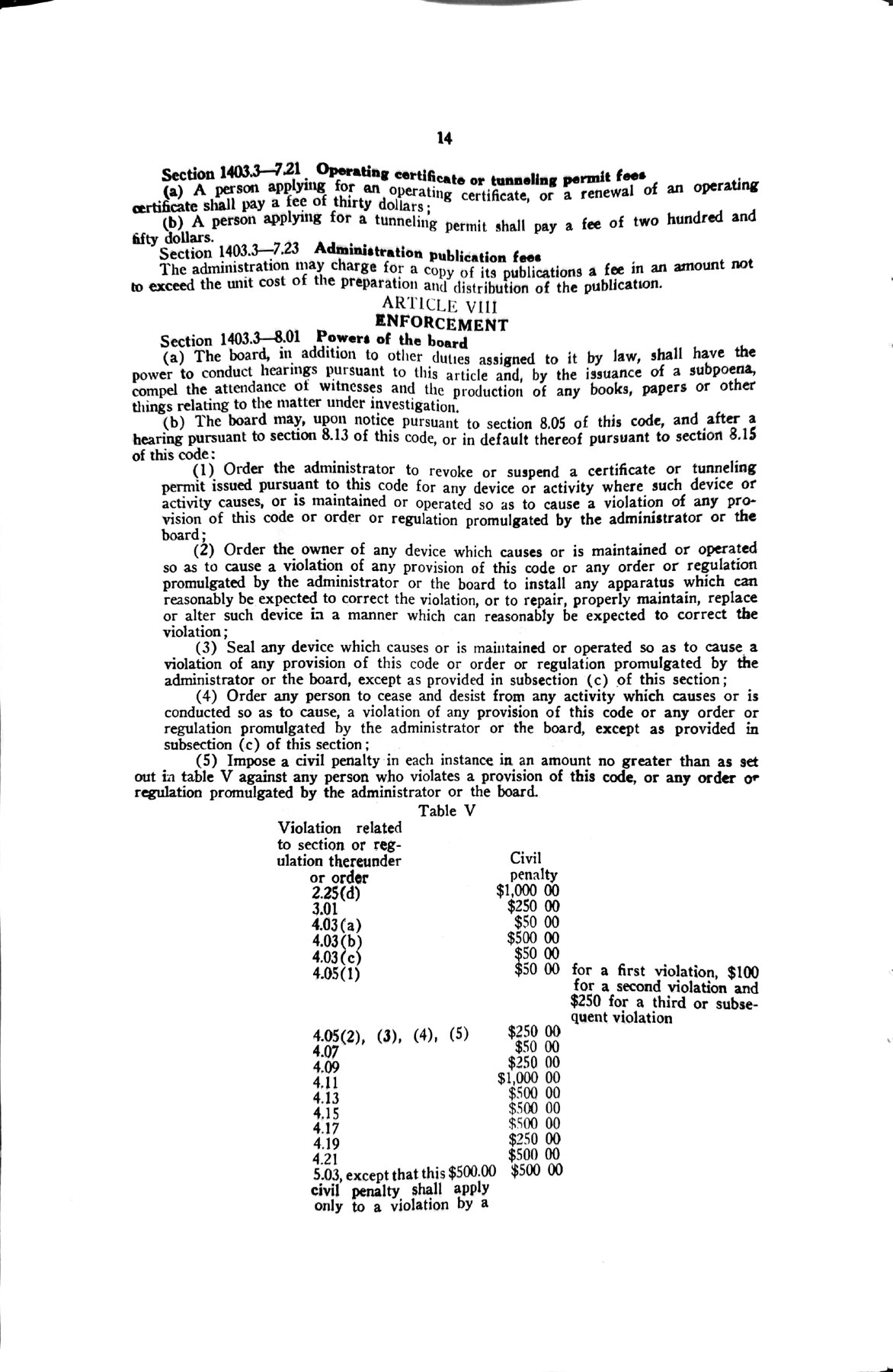
Section 1403.3—7.21 Operating certificate or tunneling permit fees
(a) A person applying for an operating certificate, or a renewal of an operating certificate shall pay a fee of thirty dollars;
(b) A person applying for a tunneling permit shall pay a fee of two hundred and fifty dollars.
Section 1403.3—7.23 Administration publication fees
The administration may charge for a copy of its publications a fee in an amount not to exceed the unit cost of the preparation and distribution of the publication.
ARTICLE VIIIENFORCEMENT
Section 1403.3—8.01 Powers of the board
(a) The board, in addition to other duties assigned to it by law, shall have the power to conduct hearings pursuant to this article and, by the issuance of a subpoena, compel the attendance of witnesses and the production of any books, papers or other things relating to the matter under investigation.
(b) The board may, upon notice pursuant to section 8.05 of this code, and after a hearing pursuant to section 8.13 of this code, or in default thereof pursuant to section 8.15 of this code:
(1) Order the administrator to revoke or suspend a certificate or tunneling permit issued pursuant to this code for any device or activity where such device or activity causes, or is maintained or operated so as to cause a violation of any provision of this code or order or regulation promulgated by the administrator or the board;
(2) Order the owner of any device which causes or is maintained or operated so as to cause a violation of any provision of this code or any order or regulation promulgated by the administrator or the board to install any apparatus which can reasonably be expected to correct the violation, or to repair, properly maintain, replace or alter such device in a manner which can reasonably be expected to correct the violation;
(3) Seal any device which causes or is maintained or operated so as to cause a violation of any provision of this code or order or regulation promulgated by the administrator or the board, except as provided in subsection (c) of this section;
(4) Order any person to cease and desist from any activity which causes or is conducted so as to cause, a violation of any provision of this code or any order or regulation promulgated by the administrator or the board, except as provided in subsection (c) of this section;
(5) Impose a civil penalty in each instance in an amount no greater than as set out in table V against any person who violates a provision of this code, or any order or regulation promulgated by the administrator or the board.
| Violation related to section or regulation thereunder or order | Civil penalty |
|---|---|
| 2.25(d) | $1,000.00 |
| 3.01 | $250.00 |
| 4.03(a) | $50.00 |
| 4.03(b) | $500.00 |
| 4.03(c) | $50.00 |
| 4.05(1) | $50.00 for a first violation, $100 for a second violation and $250 for a third or subsequent violation |
| 4.05(2), (3), (4), (5) | $250.00 |
| 4.07 | $50.00 |
| 4.09 | $250.00 |
| 4.11 | $1,000.00 |
| 4.13 | $500.00 |
| 4.15 | $500.00 |
| 4.17 | $500.00 |
| 4.19 | $250.00 |
| 4.21 | $500.00 |
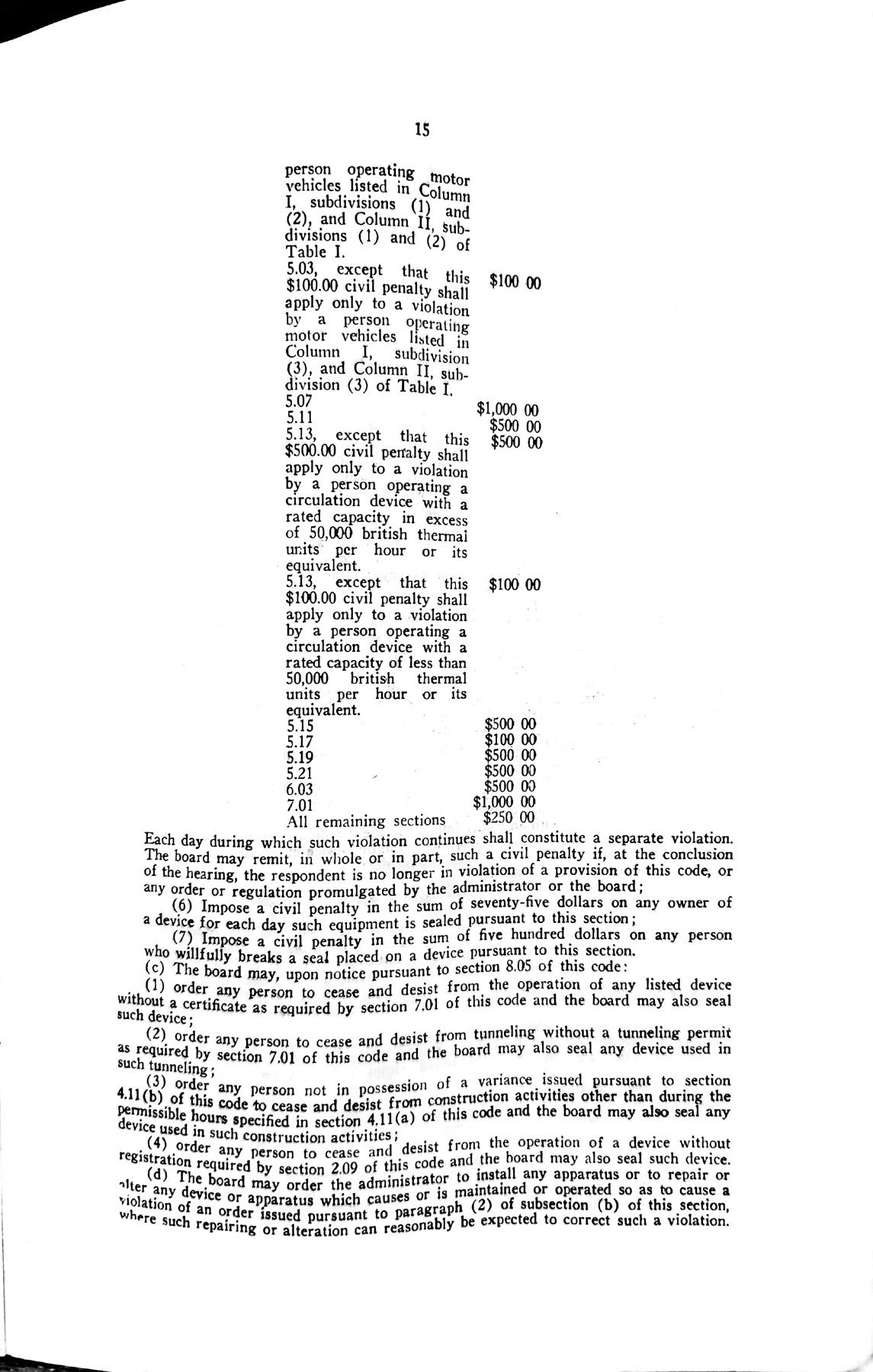
| 5.03, except that this $500.00 civil penalty shall apply only to a violation by a person operating motor vehicles listed in Column I, subdivisions (1) and (2), and Column II, subdivisions (1) and (2) of Table I. | $500.00 |
| 5.03, except that this $100.00 civil penalty shall apply only to a violation by a person operating motor vehicles listed in Column I, subdivision (3), and Column II, subdivision (3) of Table I. | $100.00 |
| 5.07 | $1,000.00 |
| 5.11 | $500.00 |
| 5.13, except that this $500.00 civil penalty shall apply only to a violation by a person operating a circulation device with a rated capacity in excess of 50,000 british thermal units per hour or its equivalent. | $500.00 |
| 5.13, except that this $100.00 civil penalty shall apply only to a violation by a person operating a circulation device with a rated capacity of less than 50,000 british thermal units per hour or its equivalent. | $100.00 |
| 5.15 | $500.00 |
| 5.17 | $100.00 |
| 5.19 | $500.00 |
| 5.21 | $500.00 |
| 6.03 | $500.00 |
| 7.01 | $1,000.00 |
| All remaining sections | $250.00 |
Each day during which such violation continues shall constitute a separate violation.
The board may remit, in whole or in part, such a civil penalty if, at the conclusion Of the hearing, the respondent is no longer in violation of a provision of this code, or any order or regulation promulgated by the administrator or the board;
(6) Impose a civil penalty in the sum of seventy-five dollars on any owner of a device for each day such equipment is sealed pursuant to this section;
(7) Impose a civil penalty in the sum of five hundred dollars on any person who willfully breaks a seal placed on a device pursuant to this section.
(c) The board may, upon notice pursuant to section 8.05 of this code:
(1) order any person to cease and desist from the operation of any listed device without a certificate as required by section 7.01 of this code and the board may also seal such device;
(2) order any person to cease and desist from tunneling without a tunneling permit as required by section 7.01 of this code and the board may also seal any device used in such tunneling;
(3) order any person not in possession of a variance issued pursuant to section
4.11 (b) of this code to cease and desist from construction activities other than during the permissible hours specified in section 4.11 (a) of this code and the board may also seal any device used in such construction activities;
(4) order any person to cease and desist from the operation of a device without registration required by section 2.09 of this code and the board may also seal such device.
(d) The board may order the administrator to install any apparatus or to repair or alter any device or apparatus which causes or is maintained or operated so as to cause a violation of an order issued pursuant to paragraph (2) of subsection (b) of this section, where such repairing or alteration can reasonably be expected to correct such a violation.
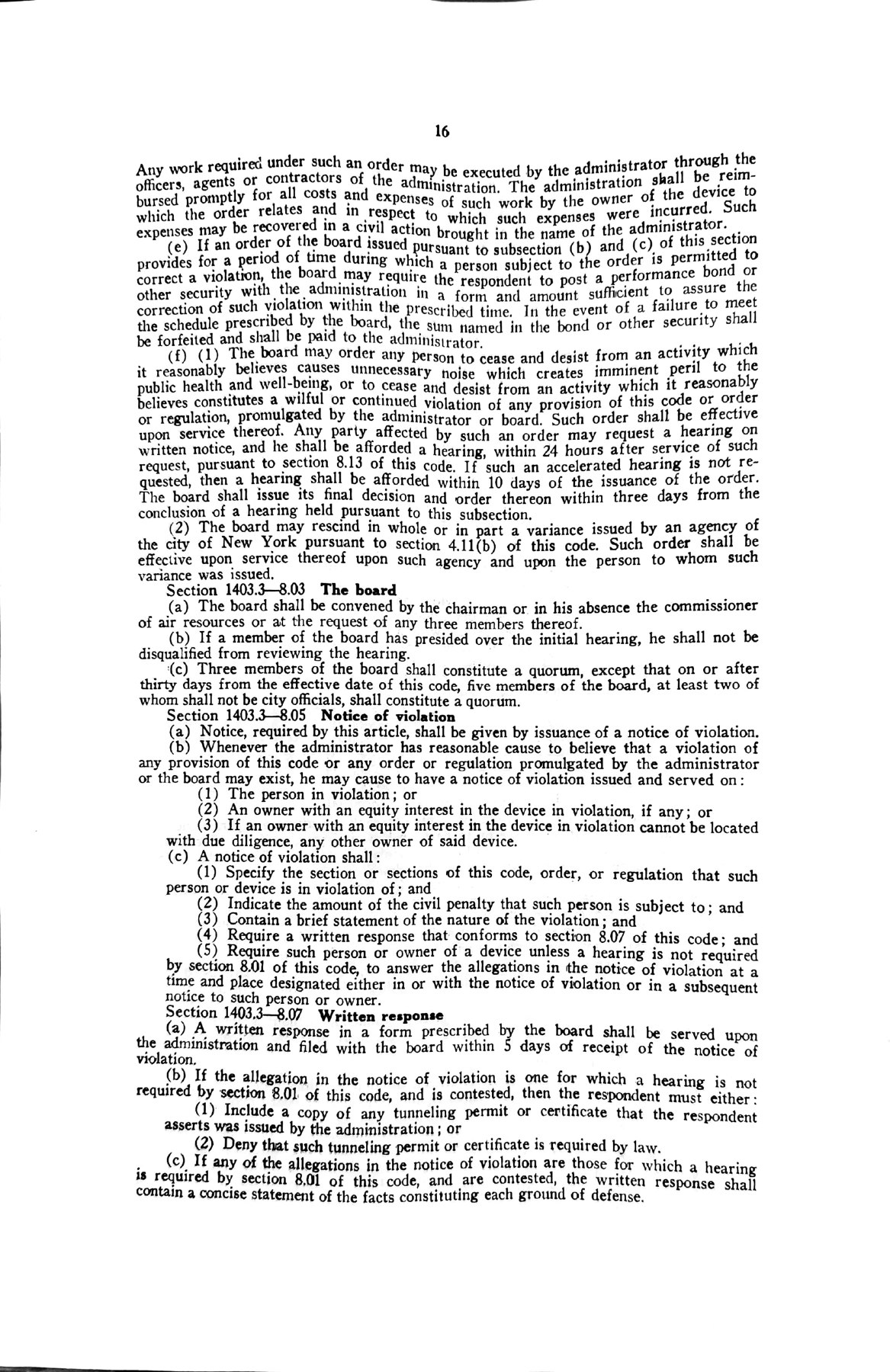
Any work required under such an order may be executed by the administrator through the officers, agents or contractors of the administration. The administration shall be reimbursed promptly for all costs and expenses of such work by the owner of the device to which the order relates and in respect to which such expenses were incurred. Such expenses may be recovered in a civil action brought in the name of the administrator.
(e) If an order of the board issued pursuant to subsection (b) and (c) of this section provides for a period of time during which a person subject to the order is permitted to correct a violation, the board may require the respondent to post a performance bond or other security with the administration in a form and amount sufficient to assure the correction of such violation within the prescribed time. In the event of a failure to meet the schedule prescribed by the board, the sum named in the bond or other security shall be forfeited and shall be paid to the administrator.
(f) (1) The board may order any person to cease and desist from an activity which it reasonably believes causes unnecessary noise which creates imminent peril to the public health and well-being, or to cease and desist from an activity which it reasonably believes constitutes a wilful or continued violation of any provision of this code or order or regulation, promulgated by the administrator or board. such order shall be effective upon service thereof. Any party affected by such an order may request a hearing on written notice, and he shall be afforded a hearing, within 24 hours after service of such request, pursuant to section 8.13 of this code. If such an accelerated hearing is not requested, then a hearing shall be afforded within 10 days of the issuance of the order. The board shall issue its final decision and order thereon within three days from the conclusion of a hearing held pursuant to this subsection.
(2) The board may rescind in whole or in part a variance issued by an agency of the city of New York pursuant to section 4.11 (b) of this code. such order shall be effective upon service thereof upon such agency and upon the person to whom such variance was issued.
Section 1403.3—8.03 The board
(a) The board shall be convened by the chairman or in his absence the commissioner of air resources or at the request of any three members thereof.
(b) If a member of the board has presided over the initial hearing, he shall not be disqualified from reviewing the hearing.
(c) Three members of the board shall constitute a quorum, except that on or after thirty days from the effective date of this code, five members of the board, at least two of whom shall not be city officials, shall constitute a quorum.
Section 1403.3—8.05 Notice of violation
(a) Notice, required by this article, shall be given by issuance of a notice of violation.
(b) Whenever the administrator has reasonable cause to believe that a violation of any provision of this code or any order or regulation promulgated by the administrator or the board may exist, he may cause to have a notice of violation issued and served on:
(1) The person in violation; or
(2) An owner with an equity interest in the device in violation, if any; or
(3) If an owner with an equity interest in the device in violation cannot be located with due diligence, any other owner of said device.
(c) A notice of violation shall:
(1) Specify the section or sections of this code, order, or regulation that such person or device is in violation of; and
(2) Indicate the amount of the civil penalty that such person is subject to; and
(3) Contain a brief statement of the nature of the violation; and
(4) Require a written response that conforms to section 8.07 of this code; and
(5) Require such person or owner of a device unless a hearing is not required by section 8.01 of this code, to answer the allegations in the notice of violation at a time and place designated either in or with the notice of violation or in a subsequent notice to such person or owner.
Section 1403.3—8.07 Written response
(a) A written response in a form prescribed by the board shall be served upon the administration and filed with the board within 5 days of receipt of the notice of violation.
(b) If the allegation in the notice of violation is one for which a hearing is not required by section 8.01 of this code, and is contested, then the respondent must either:
(1) Include a copy of any tunneling permit or certificate that the respondent asserts was issued by the administration; or
(2) Deny that such tunneling permit or certificate is required by law.
(c) If any of the allegations in the notice of violation are those for which a hearing is required by section 8.01 of this code, and are contested, the written response shall contain a concise statement of the facts constituting each ground of defense.
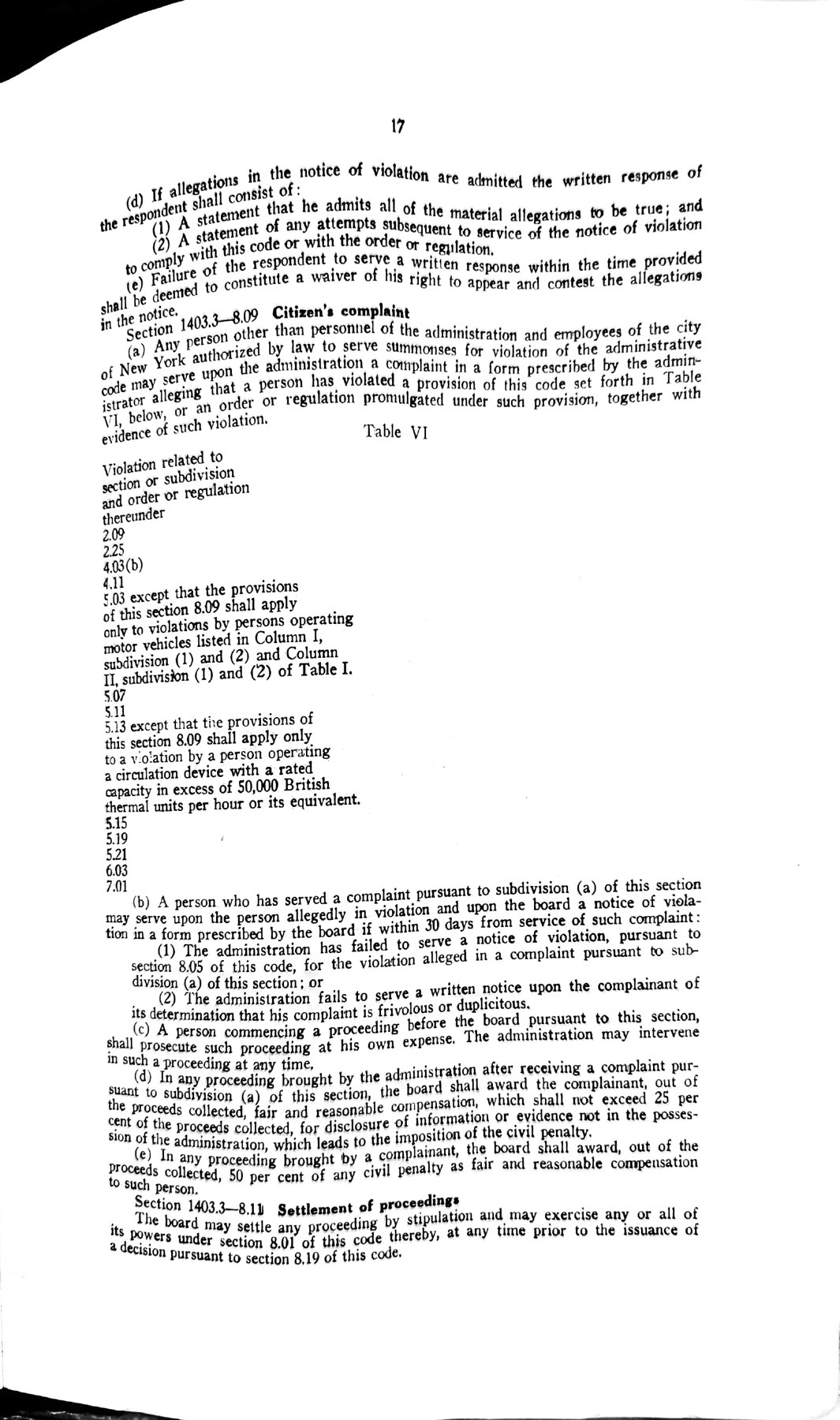
(d) If allegations in the notice of violation are admitted the written response of the respondent shall consist of:
(1) A statement that he admits all of the material allegations to be true; and
(2) A statement of any attempts SUbsequent to service of the notice of violation to comply with this code or with the order or regulation.
(e) Failure of the respondent to serve a written response within the time provided shall be deemed to constitute a waiver of his right to appear and contest the allegations in the notice.
Section 1403.3—8.09 Citizen’s complaint
(a) Any person other than personnel of the administration and employees of the city of New York authorized by law to serve summonses for violation of the administrative code may serve upon the administration a Complaint in a form prescribed by the administrator alleging that a person has violated a provision of this code set forth in Table VI, below, or an order or regulation promulgated under such provision, together with evidence of such violation.
| Violation related to section or subdivision and order or regulation thereunder |
|---|
| 2.09 |
| 2.25 |
| 4.03(b) |
| 4.11 |
| 5.03 except that the provisions of this section 8.09 shall apply only to violations by persons operating motor vehicles listed in Column I, subdivision (1) and (2) and Column II, subdivision (1) and (2) of Table I. |
| 5.07 |
| 5.11 |
| 5.13 except that the provisions of this section 8.09 shall apply only to a violation by a person operating a circulation device with a rated capacity in excess of 50,000 British thermal units per hour or its equivalent. |
| 5.15 |
| 5.19 |
| 5.21 |
| 6.03 |
| 7.01 |
(b) A person who has served a complaint pursuant to subdivision (a) of this section may serve upon the person allegedly in violation and upon the board a notice of violation in a form prescribed by the board if within 30 days from service of such complaint:
(1) The administration has failed to serve a notice of violation, pursuant to section 8.05 of this code, for the violation alleged in a complaint pursuant to subdivision (a) of this section; or
(2) The administration fails to serve a written notice upon the complainant of its determination that his complaint is frivolous or duplicitous.
(c) A person commencing a proceeding before the board pursuant to this section, shall prosecute such proceeding at his own expense. The administration may intervene in such a proceeding at any time.
(d) In any proceeding brought by the administration after receiving a complaint pursuant to subdivision (a) of this section, the board shall award the complainant, out of the proceeds collected, fair and reasonable compensation, which shall not exceed 25 per cent of the proceeds collected, for disclosure of information or evidence not in the possession of the administration, which leads to the imposition of the civil penalty.
(e) In any proceeding brought by a complainant, the board shall award, out of the proceeds collected, 50 per cent of any civil penalty as fair and reasonable compensation to such person.
Section 1403.3—8.11 Settlement of proceedings
The board may settle any proceeding by stipulation and may exercise any or all of its powers under section 8.01 of this code thereby, at any time prior to the issuance of a decision pursuant to section 8.19 of this code.
Section 1403.3—8.13 Hearings
(a) The chairman of the board shall designate a hearing officer or at least one member of the board to preside over hearings held pursuant to this article. In any hearing in which a quorum of the board is present, such members shall be deemed to be sitting as the board.
(b) All such hearings shall be open to the public.
(c) At the request of any party to such a hearing, the board shall by the issuance of a subpoena compel the attendance of such witnesses and shall require the production of any such books, papers, or other things relating to the matter under investigation if such a request reasonably relates to such hearing.
(d) Any party to a hearing may be represented by counsel, may make oral and written argument and cross-examine witnesses. All testimony taken before the board or the designated hearing officer shall be under oath and shall be recorded. The record shall be open to public inspection, and copies thereof shall be made available to any person upon payment of the actual cost of reproduction.
Section 1403.3—8.15 Default; vacating a default order
(a) A respondent shall be in default when the respondent has:
(1) Failed to serve a written response pursuant to section 8.07 of this code; or
(2) Failed to appear at the designated time and place as required by the notice of violation or subsequent notice pursuant to section 8.05 or 8.09 of this code; or
(3) Neglected to proceed in a manner ordered by the board.
(b) Within 60 days of a decision and order of the board issued pursuant to section
8.19 (c) (2), the respondent may request the board to grant a stay of such order of the board and schedule a hearing. If the respondent has shown good cause and a meritorious defense, the board may grant such a request and hold a hearing pursuant to section 8.13 of this code. At the conclusion of the hearing, the board may adopt, amend or rescind its decision and order.
Section 1403.3—8.17 Hearing officer’s decision
(a) At the conclusion of the hearing, the hearing officer or member of the board conducting the hearing shall prepare a decision stating findings of fact and conclusions, as well as reasons for his determination on all material issues, and making recommendations as to action which should be taken in the matter.
(b) The hearing officer or member of the board conducting the hearing shall file his decision with the board and send copies by mail to the parties. Any party may file exceptions with the board within 20 days after service of such decision. If no exceptions have been filed within the described time the recommendations of the hearing officer or member of the board conducting the hearing shall automatically become the decision of the board and shall constitute its findings, conclusions and order.
(c) At the conclusion of a hearing conducted by the board, the board shall issue its decision and order. The decision of the board shall conform to the requirements of subdivisions (b) and (c) of section 8.19 of this code.
Section 1403.3—8.19 Board decision and order
(a) If any party files exceptions to the decision of the hearing officer or member of the board conducting a hearing within the prescribed time the board shall review the record and issue its decision and order in which it may adopt, modify or reject the findings, conclusions and recommendations of the hearing officer or member of the board who conducted the hearing.
(b) The decision of the board shall contain findings of fact, conclusions of law and reasons for the decision on all material issues raised, and an order either dismissing the allegations of the notice of violation or sustaining them in whole or in part.
(c) The board may exercise one or more of its powers pursuant to section 8.01 of this code, as it deems appropriate if:
(1) The allegations in the notice of violation are sustained in whole or in part;
(2) The respondent is in default under section 8.15 of this code.
(d) The decision and order of the board shall be its final determination. A judicial proceeding must be commenced within two months after the service of such decision and order.
Section 1403.3—8.21 Compliance with board decisions; orders and civil penalties
(a) If the respondent fails or refuses to comply with the board's order, or the board otherwise deems it necessary, the corporation counsel for the city of New York, acting in the name of the city, may maintain an action or proceeding in a court of competent jurisdiction to compel compliance with or restrain by injunction the violation of any order of the board.
(b) A civil penalty imposed by the board pursuant to section 8.01 of this code may be collected in an action brought in the name of the city of New York.
Section 1403.3—8.23 Procedural rules
The board shall have authority from time to time to make, amend and rescind such procedural rules as may be necessary to carry out the provisions of this article.
Section 1403.3—8.25 Criminal penalties
(a) Any person who shall knowingly make a false statement or who shall knowingly falsify or allow to be falsified any certification, registration, form, signed statement, application or report required under the provisions of this code or regulation promulgated by the administrator or the board shall be guilty of a misdemeanor and, upon conviction thereof, shall be punished by a fine of not less than one hundred dollars, nor more than one thousand dollars, or by imprisonment not to exceed five months, or both.
(b) Any person, other than a corporation, who violates any order of the administrator or the board or any provision of section 7.01 of this code or who illegally breaks a seal on equipment, upon conviction shall be punished for each offense by a fine of not less than fifty dollars nor more than five hundred dollars or by imprisonment for not more than thirty days or by both.
Any corporation which violates any order of the administrator or the board or any provision of section 7.01 of this code, or which illegally causes a seal to be broken upon conviction shall be punished for each offense by a fine of not less than one hundred dollars nor more than two thousand dollars.
Every day during which such violation occurs constitutes a separate offense.
(c) Any person, other than a corporation, convicted of willful failure to pay a civil penalty imposed by the board pursuant to section 8.01 of this code shall be punished by a fine of double the amount of the civil penalty imposed by the board or by imprisonment of not more than sixty days or by both.
Any corporation convicted of wilful failure to pay a civil penalty imposed by the board pursuant to section 8.01 of this code shall be punished by a fine of double the amount of the civil penalty imposed by the board, but not more than two thousand dollars.
(d) The failure of any person or corporation against whom an action has been brought to collect a civil penalty pursuant to section 8.21 (b) of this code, who has been found liable by a court for such civil penalty and who does not pay such penalty after the judgment of such becomes final, shall be deemed guilty of a willful failure to pay a civil penalty.
(e) Any person convicted of violating any of the provisions of this code or any regulation of the board not otherwise provided for by this section shall be punished by a fine of not less than fifty dollars nor more than five hundred dollars for the first offense, or by imprisonment for twenty days or both, and by a fine of not less than one hundred dollars nor more than one thousand dollars or by imprisonment for not more than thirty days or both, for a second offense, and by a fine of not less than four hundred dollars nor more than five thousand dollars or by imprisonment for not more than four months or both for a third or subsequent offense.
(f) Twenty-five per cent of any fine that is imposed pursuant to this section may be paid to the person or persons giving information which shall lead to conviction.
§ 3. Section fourteen hundred four of the New York city charter, as amended by local law forty-nine for the year nineteen hundred seventy-one, is hereby amended to read as follows:
§ 1404. Environmental control board
1. There shall be in the administration an environmental control board consisting of the administrator, who shall be chairman, the commissioner in the administration who is responsible for air pollution control, the commissioner in the administration who is responsible for water pollution control, the commissioner in the administration who is responsible for sanitation, the commissioner of the department of buildings of the housing and development administration and four persons, to be appointed by the mayor, with the advice and consent of the city council, who are not officers in the administration at least one to be possessed of a broad general background and experience in the field of air pollution control, one with such background and experience in the field of water pollution control, and one with such background and experience in the field of noise pollution control, and who shall serve for four-year terms except that two of the first of such persons taking office shall be appointed for a two-year term. These four members shall be compensated at the rate of one hundred dollars per day when performing the work of the board. Within its appropriation, the board may appoint an executive director and such hearing officers including non-salaried hearing officers, and other employees as it may from time to time find necessary for the proper performance of its duties.
2. The environmental control board shall have jurisdiction to adopt and amend rules not inconsistent with any provisions of law:
(a) regulating or prohibiting the emission into the open air from any source, whether fixed or movable, and whether on land or water of any harmful or objectionable substances, including, but not limited to, smoke, soot, fly ash, dust, fumes, gas vapors and odors, and the installation, construction or alteration of equipment giving forth such emissions into the open air insofar as such emissions are affected thereby; and
(b) regulating or prohibiting the emissions into the waters within and about the city of New York from any source whether fixed or movable and whether on land or water of any harmful or objectionable substances, contaminants and pollutants.
3. The environmental control board shall enforce the provisions of the charter and the administrative code, and any rules and regulations made thereunder, which relate to the cleanliness of the streets, the disposal of wastes, the provision of a pure, wholesome and adequate supply of water, and the prevention of air, water and noise pollution. The board shall have authority from time to time to make, amend and rescind such rules and regulations as may be necessary to carry out its duties under this subdivision.
§ 4. Section 1403.2—15.03 of chapter 57 of the administrative code as added by local law 49 for the year 1971 is hereby amended as follows:
§ 1403.2—15.03 The board
(a) The board shall be convened by the chairman or in his absence the commissioner of air resources or at the request of any three members thereof.
(b) If a member of the board has presided over the initial hearing, he shall not be disqualified from reviewing the hearing.
(c) Three members of the board shall constitute a quorum, except that on or after thirty days from the effective date of section 1043.3—8.03 of this chapter, five members of the board, at least two of whom shall not be city officials, shall constitute a quorum.
§ 5. Section 1403.2—15.13 of such chapter of such code as added by such local law is hereby amended as follows:
§ 1403.2—15.13 Hearings
(a) The chairman of the board shall designate a hearing officer or at least one member of the board to preside over hearings held pursuant to this article. In any hearing in which a quorum of the board is present such members shall be deemed to be sitting as the board.
(b) All such hearings shall be open to the public.
(c) At the request of any party to such a hearing, the board shall by the issuance of a subpoena compel the attendance of such witnesses and shall require the production of any such books, papers, or other things relating to the matter under investigation if such a request reasonably relates to such hearing.
(d) Any party to a hearing may be represented by counsel, may make oral and written argument and cross-examine witnesses. All testimony taken before the board or the designated hearing officer shall be under oath and shall be recorded. The record shall be open to public inspection, and copies thereof shall be made available to any person upon payment of the actual cost of reproduction.
§ 6. This local law shall take effect September 1, 1972.
THE CITY OF NEW YORK, OFFICE OF THE CITY CLERK, S.S.:
I hereby certify that the foregoing is a true copy of a local law of The City of New York, passed by the Council on September 12, 1972 and approved by the Mayor on October 4, 1972.
HERMAN KATZ, City Clerk, Clerk of the Council.
Certification Pursuant to Municipal Home Rule Law Section 27
Pursuant to the provisions of Municipal Home Rule Law Section 27, I hereby certify that the enclosed local law (Local Law 57 of 1972, Council Int. No. 661-A) contains the correct text and; Received the following vote at the meeting of the New York City Council on September 12, 1972: 31 for, 5 against. Was approved by the Mayor on October 4, 1972. Was returned to the City Clerk on October 5, 1972.
NORMAN REDLICH, Corporation Counsel.